
What Is Cinema LED Display Technology? A Practical Guide for Theaters and LED Professionals
- Tse Cherie
- Jun 29
- 10 min read

Cinema LED display technology is a direct view display solution for theaters that uses self-emissive LED pixels to create images without a projector or reflective screen. Unlike traditional cinema projection, where light is projected onto a screen and reflected back to the audience, a cinema LED screen emits light directly from the display surface. This gives it a different performance profile in brightness, contrast, image consistency, and system design.
In recent years, cinema LED has moved from a niche concept into a serious option for premium auditoriums, HDR-oriented presentation, and new-generation theater projects. For engineers, system integrators, procurement teams, and B2B buyers, the value of cinema LED lies not only in image quality, but also in how it changes the display architecture, control chain, maintenance model, and auditorium integration logic.
1. What Is Cinema LED Display Technology?
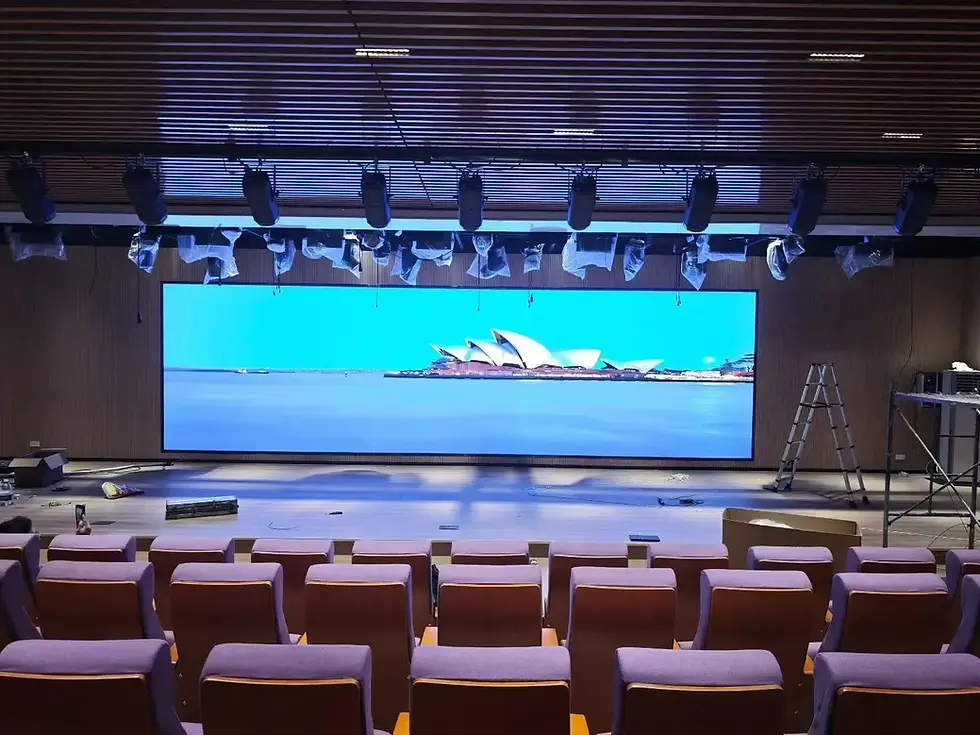
Cinema LED display technology refers to the use of a large-format direct view LED screen for movie presentation in a cinema. The image is formed directly on the screen by red, green, and blue LED emitters arranged into pixels, rather than by a projector and reflective silver screen.
This is why cinema LED is often classified as direct view display technology. It belongs to the same broader display family as other self-emissive systems, but in practical cinema applications, LED is currently the main large-format direct display route. While OLED is also self-emissive, it is generally better suited to smaller display sizes such as TVs, tablets, and monitors, rather than the very large screens required in movie theaters.
From an industry perspective, cinema LED is important because it changes the traditional cinema display path. Instead of relying on optical projection, it creates the image at the screen surface itself, which opens new possibilities for luminance performance, contrast, and HDR presentation. This also means the technology should not be understood only as a new screen type, but as a different display architecture with its own optical, electrical, and operational logic.
In a conventional projector-based theater, the image quality is influenced by the projector, the lens system, the projection path, and the reflective characteristics of the screen. In a cinema LED system, the display surface itself becomes the imaging device. As a result, the discussion shifts from projection efficiency to pixel design, screen uniformity, control precision, and direct-view visual performance.
2. How Does a Cinema LED Display Work?
A cinema LED display works through a combination of self-emissive pixel imaging and an LED control system.
At the pixel level, each display pixel contains red, green, and blue light-emitting elements. By adjusting the output of these RGB sub-pixels, the system creates the required color and brightness for each image point. When millions of pixels work together, the screen reproduces a full moving image.
At the system level, the signal chain usually includes:
digital cinema playback controller
LED controller
sending card
receiving card
driver IC
LED modules and cabinets
The basic signal path is:
content source → playback controller → LED controller → sending card → receiving card → driver IC → LED pixels
This means the cinema LED screen is only one part of the full system. Actual image quality depends on both the display hardware and the control chain, including image processing, calibration, grayscale management, synchronization, and cabinet communication stability.
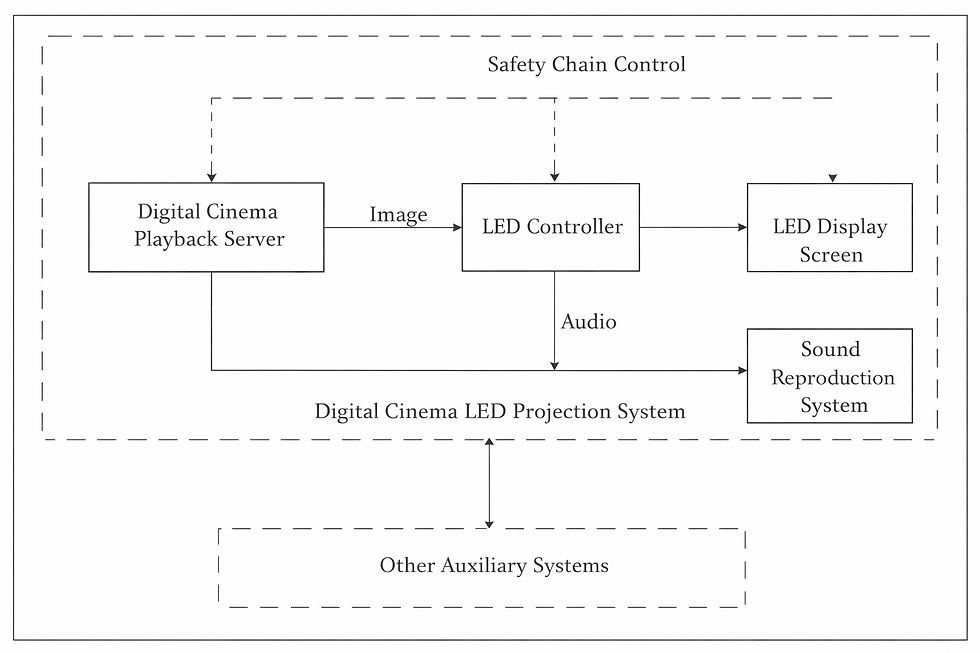
Because cinema content has higher expectations than many standard indoor LED applications, the system must also control low-brightness performance, image scaling behavior, sub-pixel consistency, and viewing-angle uniformity.
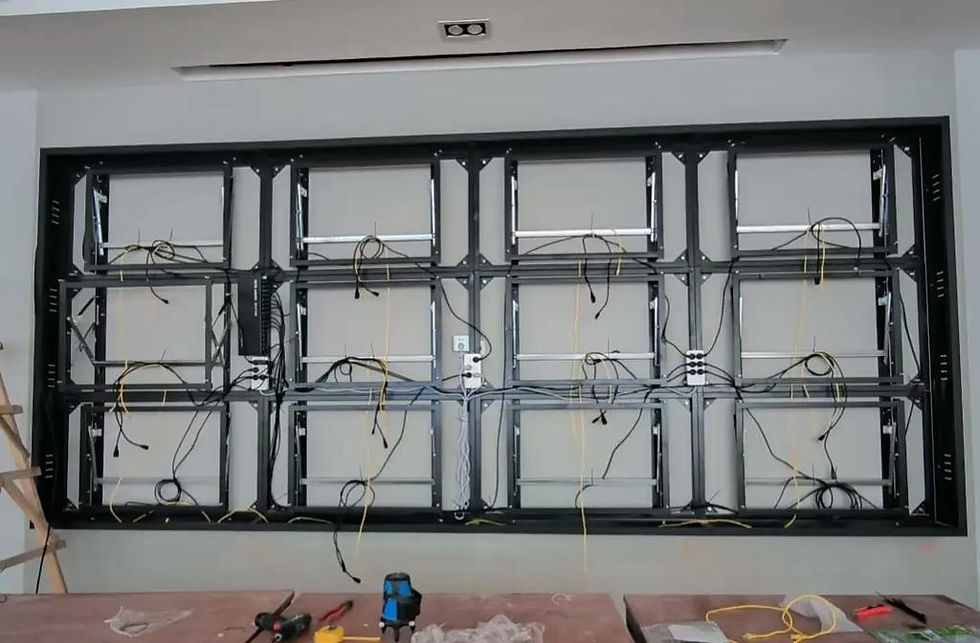
From a structural point of view, the display is assembled layer by layer. The complete screen is built from cabinets, the cabinets contain modules, and the modules contain pixel arrays. This modular design is one of the reasons cinema LED can be adapted to different auditorium sizes and resolutions. It also affects maintenance, because service work is often performed at the module or cabinet level rather than by replacing the whole screen.
Another important point is that cinema LED performance is not determined by brightness alone. The system must handle grayscale tracking, image uniformity, and stable reproduction of subtle shadow detail. In some cases, spatial or temporal dithering may be used to improve low-level rendering, but this must be controlled carefully so that the audience does not perceive unwanted visual noise.
3. What Types of Cinema LED Display Structures Are Available?
Cinema LED screens are modular systems built from smaller units. The common structural hierarchy is:
3.1 Screen
The full cinema screen is assembled from multiple LED cabinets to form one seamless large-format display. In practical projects, screen size depends on auditorium dimensions, seating distance, and target presentation format. Small screening rooms and premium large-format auditoriums may use very different screen dimensions, but the same structural principle still applies.
3.2 Cabinet
A cabinet is the main structural and electrical assembly unit. It contains part of the display area along with power, signal, and mounting components. Cabinet design influences installation efficiency, structural alignment, service access, and overall screen flatness. In cinema applications, cabinet precision is especially important because visible seams or unevenness can affect image consistency.
3.3 Module
A module is a smaller display unit installed inside the cabinet. It contains a matrix of pixels and is often the smallest field-replaceable light-emitting assembly. Modules are important not only for manufacturing and assembly, but also for calibration and maintenance. If a failure occurs, technicians often replace a module rather than servicing individual pixels on site.
3.4 Pixel
A display pixel is the smallest image-forming unit. In full-color LED screens, it is usually made of red, green, and blue emitters. Pixel design affects color mixing, luminance performance, viewing-angle behavior, and visible pixel structure. For cinema use, pixel visibility must be controlled carefully so that the audience perceives a continuous image instead of a grid-like pattern.
3.5 Package technology
At the packaging level, fine-pitch LED displays may use routes such as:
SMD
IMD
GOB
COB
In cinema projects, package choice affects optical performance, reliability, maintenance, and consistency. Different package technologies offer different trade-offs in protection, integration level, repairability, and visual behavior. The right choice depends on project requirements rather than on a single universally preferred route.
4. Where Is Cinema LED Display Technology Used?
The most obvious application is movie presentation, but cinema LED can also support broader theater-related use cases.
4.1 Commercial theaters
Cinema LED is used in movie auditoriums as an alternative to projector-based systems. In this role, it serves as the main display platform for feature films, trailers, and standard cinema playback content.
4.2 Premium-format screens
It is especially suitable for premium theaters that want stronger image impact, high contrast, or a more differentiated visual experience. In such projects, the display often becomes part of the auditorium’s premium positioning rather than just a replacement for conventional projection equipment.
4.3 HDR-oriented theaters
Because LED can support higher luminance, it is well suited to HDR-capable cinema environments. This makes cinema LED particularly relevant to theaters that want to align with the broader industry interest in higher dynamic range image presentation.
4.4 Multi-purpose auditoriums
Some venues also use cinema LED screens for:
advertising
premieres
private screenings
live events
esports or alternative content
This flexibility can increase the functional value of the auditorium, especially in venues that want to support more than standard movie scheduling.
4.5 Boutique and specialized screening rooms
Smaller screening rooms, preview theaters, and specialized presentation spaces may also benefit from cinema LED. In these environments, modular design and direct-view performance can offer operational and visual advantages.
This makes cinema LED relevant not only as a movie screen, but also as a versatile display platform for modern exhibition spaces. Its application value grows when venue operators want one display system to support both cinema-grade presentation and other high-quality visual uses.
5. What Are the Main Advantages of Cinema LED Displays?
Cinema LED technology offers several practical advantages.
5.1 Higher brightness potential
Cinema LED can achieve much higher screen brightness than traditional projection systems, which is one reason it is often discussed in connection with HDR. This higher brightness potential does not automatically guarantee better presentation in every case, but it expands the performance range available to the theater.
5.2 Strong contrast performance
Because it is self-emissive, cinema LED can deliver high contrast without depending on reflected light. This is especially important in scenes with strong dark-to-bright transitions or where image depth and punch matter.
5.3 Direct image output
The image is created directly on the display surface, avoiding light loss associated with projection and screen reflection. This changes the image path fundamentally and can improve display efficiency.
5.4 Scalable screen design
LED cabinets and modules can be combined into different screen sizes and resolutions for different auditorium types. This gives integrators flexibility when planning installations for compact, standard, or premium-format theaters.
5.5 Long service life
With proper design and maintenance, LED systems can support long operating life. This is attractive to operators who evaluate technology not only on presentation quality but also on long-term asset value.
5.6 Flexible digital control
Cinema LED works with a digital control architecture that supports calibration, screen mapping, and detailed image management. This is useful for achieving consistency across large display surfaces.
5.7 Stable image behavior over time
Compared with systems that depend on projection components and reflective surfaces, cinema LED can offer a more direct and controlled image platform. This can support stable performance when the system is designed, calibrated, and maintained correctly.
6. What Are the Limitations of Cinema LED Technology?
Cinema LED also has limitations that should be considered carefully.
6.1 High initial investment
Compared with many conventional projection systems, cinema LED usually requires a higher upfront budget. For many projects, this is one of the first factors considered during feasibility assessment.
6.2 Tight pixel-pitch requirements
If the pixel pitch is not matched well to viewing distance, viewers may notice pixel structure or image artifacts. In cinema environments, where audiences watch the screen continuously for long periods, this requirement becomes especially important.
6.3 Uniformity control challenges
Since the screen is assembled from cabinets and modules, consistency between modules, cabinet boundaries, and adjacent pixels must be tightly managed. Small inconsistencies that might be acceptable in some commercial display environments may be more noticeable in cinema.
6.4 More complex integration
Cinema LED involves screen mechanics, power, control electronics, playback compatibility, thermal design, and often new acoustic planning. As a result, integration work is usually more complex than simply replacing one display device with another.
6.5 Maintenance planning is still essential
Although cinema LED avoids some projector-related issues, it still requires spare modules, calibration procedures, and service support. Long-term maintenance strategy remains an important part of ownership.
6.6 Audio integration constraints
Traditional cinema design often places speakers behind the projection screen. A direct view LED wall changes this arrangement and may require a different loudspeaker layout or acoustic design approach.
6.7 Standards and workflow adaptation
Cinema is a standards-based environment. A display system may perform well in general LED applications but still require additional consideration before it is suitable for cinema-grade workflows and audience expectations.
7. How Should You Choose the Right Cinema LED Display?
A good selection process should consider technical fit, long-term operation, and project constraints at the same time.
7.1 Start with the application
Define the actual use case first:
standard movie auditorium
premium theater
boutique screening room
HDR-focused room
multi-purpose venue
Different environments create different priorities. For example, a premium auditorium may place greater emphasis on image impact and consistency, while a multi-purpose venue may care more about flexibility and operating efficiency.
7.2 Review pixel pitch and viewing distance
In cinema, viewing distance is critical. Smaller pitch becomes more important as the audience gets closer to the screen. This is one of the most important selection factors because it directly affects whether viewers perceive the image as smooth and natural.
7.3 Check control system compatibility
Review compatibility with the LED control ecosystem, including:
LED controller
sending card
receiving card
playback system
control software
video processor where applicable
A cinema installation depends on the stability of the complete control chain, not only on the display surface itself.
7.4 Evaluate reliability and maintenance
Ask about module replacement, spare-part continuity, calibration after service, and available technical support. A system that performs well in a showroom but is difficult to maintain in real operation may not be the right choice.
7.5 Review image consistency and optical behavior
Beyond brightness and resolution, buyers should also review uniformity, grayscale behavior, viewing-angle performance, and low-brightness rendering. These factors strongly affect perceived image quality in cinema conditions.
7.6 Compare total cost, not only purchase price
Selection should consider installation, maintenance, service response, and lifecycle cost, not just initial hardware pricing. In many cases, long-term operational value matters more than the lowest entry price.
8. Which Brands Are Common in the Cinema LED Market?
The cinema LED market includes several types of suppliers.
8.1 Global display brands
Some international display companies offer dedicated cinema LED solutions for premium auditorium projects. These suppliers often have strong manufacturing resources and broad project visibility.
8.2 Professional LED display manufacturers
There are also specialized LED display companies with strong experience in fine-pitch display design and project-based integration. These firms may offer more flexible product structures or project customization.
8.3 Control system ecosystem suppliers
Actual system performance also depends on upstream and downstream partners such as controller vendors, sending card and receiving card suppliers, driver IC providers, and calibration software vendors.
For buyers, brand evaluation should be based on cinema experience, technical support, ecosystem maturity, and long-term service capability rather than name recognition alone. A supplier’s practical ability to support installation, maintenance, and future servicing often matters as much as the product specification sheet.
9. What Technical Specifications Matter Most?
When evaluating cinema LED, several technical factors deserve close attention:
pixel pitch
resolution
brightness capability
contrast behavior
uniformity
viewing-angle performance
sub-pixel consistency
grayscale tracking
controller loading capacity
cabinet communication reliability
maintenance access
In cinema applications, these factors often matter more than a single headline specification.
Pixel pitch affects viewing smoothness. Resolution affects image detail and mapping. Brightness and contrast influence overall visual performance. Uniformity determines whether the screen looks seamless across the full image area. Viewing-angle performance matters because audiences are distributed across the auditorium rather than seated at one fixed central point.
Grayscale tracking and sub-pixel consistency affect subtle tonal transitions and color stability. Controller loading capacity and cabinet communication influence whether the system can run reliably at scale. Maintenance access determines how practical the system will be over years of operation.
In other words, cinema LED should be evaluated as a full display platform, not just as a bright screen.
10. Conclusion
Cinema LED display technology is a direct view display route that brings self-emissive imaging into the theater environment. Its core value lies in direct image formation, high luminance potential, strong contrast, and modular screen construction. At the same time, it requires careful attention to pixel pitch, control architecture, uniformity, maintenance strategy, and auditorium integration.
For engineers and system integrators, cinema LED should be treated as a complete system rather than just a screen. For procurement teams and B2B buyers, the key is to evaluate long-term fit instead of focusing only on top-line specifications. A successful cinema LED project depends on the balance between display performance, system compatibility, serviceability, and real operational needs.
As theater display technology continues to evolve, cinema LED is becoming an increasingly important option for projects that want to move beyond the limitations of traditional projection. Its future role will depend not only on image performance, but also on how well it fits the technical, commercial, and operational realities of modern cinema environments.


Comments