
How to Install an Outdoor Double-Column LED Display for Residential Communities
- Tse Cherie
- 12 minutes ago
- 11 min read

Quick Answer: How Is an Outdoor Double-Column LED Display Installed?
An outdoor double-column LED display is installed by first preparing concrete foundations and steel columns, then delivering the factory-prefabricated LED cabinet to the site for inspection. After that, the screen body is lifted into position, fixed to the two columns, connected with power and signal cables, protected with waterproof treatment, configured through the LED control system, and finally tested, calibrated, and delivered for use.
This installation method is widely used for residential community entrances, public information areas, commercial plazas, parks, schools, and smart community projects.
Project Overview: LED Information Screen for Fuguiyuan Residential Community

In the intelligent facility upgrade project of Fuguiyuan Residential Community, an outdoor double-column full-color LED information screen was successfully installed at the community entrance.
The complete construction process included:
Factory-prefabricated LED cabinet delivery
On-site unpacking and inspection
Screen positioning before lifting
Double-column structural fixing
Power and signal cable connection
Outdoor waterproof treatment
LED control system configuration
Power-on testing
Display calibration
Final project delivery
The screen is mainly used for property notices, community announcements, public service information, event updates, safety reminders, emergency messages, and community image promotion.
Compared with a traditional printed notice board, the outdoor LED information screen allows property managers to update content faster and manage information more efficiently. It also improves the visual image of the residential community and supports smart community digital management.
What Is an Outdoor Double-Column LED Display?
An outdoor double-column LED display is a full-color LED screen installed on two independent steel columns and supported by concrete foundations. It is designed for long-term outdoor operation and can display videos, images, text, notices, advertisements, and public information.
This type of LED display is commonly used in:
Residential community entrances
Property service areas
Commercial plazas
Parks and scenic areas
School entrances
Government service centers
Public squares
Outdoor advertising areas
Transportation entrance zones
Smart community projects
The double-column structure provides stable support for the screen body and is especially suitable for wider outdoor LED displays. It offers better load distribution, wind resistance, rear maintenance access, and installation flexibility compared with many wall-mounted or single-column solutions.
How Does a Double-Column LED Display System Work?
A double-column LED display system works through the coordination of the LED screen body, support structure, power system, signal transmission system, and control system.
The front display surface is made of LED modules. Each LED module contains LED lamp beads that generate full-color images and videos. These modules are installed into waterproof LED cabinets, which protect internal components from rain, dust, humidity, and outdoor environmental impact.
Inside the cabinet, power supplies provide stable electricity to the LED modules and control cards. The signal is transmitted from a computer, media player, cloud platform, or control device to the LED display system.
Depending on the project configuration, the system may include:
LED modules
Waterproof LED cabinets
Power supplies
Receiving cards
Sending card
Video processor
Media player
Control software
Network cables
Power cables
Grounding system
Steel support structure
The sending card sends image and video data to the display system. The receiving card receives and distributes the signal to the LED modules. The video processor helps adjust signal input, resolution, scaling, and display layout. The control software is used to manage content, brightness, playback schedules, and screen settings.
For residential community projects, the system can be used to publish property announcements, safety reminders, festival greetings, public service content, emergency notices, and community promotional videos.
Typical Configuration of an Outdoor Double-Column LED Display
Item | Configuration |
Application | Residential Community Entrance |
Display Type | Outdoor Full-Color LED Display |
Installation Method | Double-Column Standing Installation |
Structure | Hot-Dip Galvanized Steel Columns |
Foundation | Independent Concrete Foundations |
Cabinet Type | Waterproof LED Cabinet |
Maintenance Method | Rear Maintenance |
Control Method | Network Control / Control Software |
Content Type | Notices, Images, Videos, Scrolling Text |
Main Use | Property Notices, Community Promotion, Public Information |
System Components | LED Control System, Sending Card, Receiving Card, Video Processor |
Cable Type | Power Cable and Signal Transmission Cable |
Step 1: Factory-Prefabricated LED Cabinet Delivery and Inspection
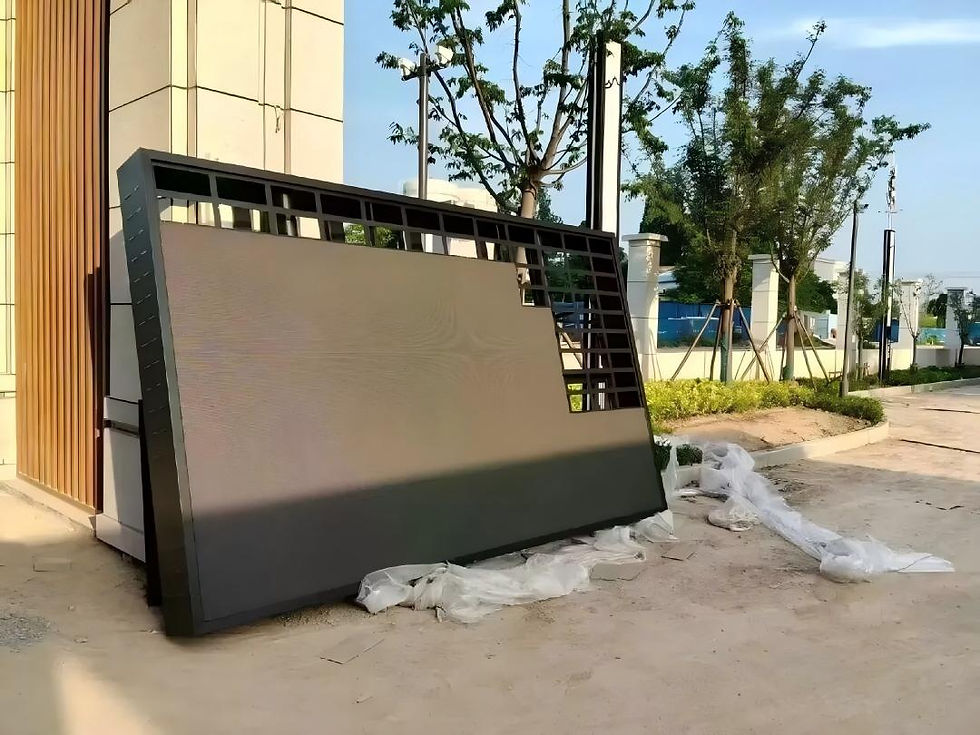
For this project, the LED display adopted an integrated prefabricated cabinet production method. Instead of assembling LED modules one by one at the construction site, the main display structure was completed in advance at the factory.
Before delivery, the factory completed:
LED module assembly
Waterproof cabinet production
Rear steel maintenance frame welding
Outer frame sealing
Cabinet reinforcement
Basic internal wiring
Structural inspection
Packaging protection
After the equipment arrived at the Fuguiyuan Residential Community site, the LED screen body was wrapped with protective plastic film. Control equipment, wiring accessories, fixed parts, and installation components were delivered together.
The back of the LED screen used a grid-type hollow steel frame structure. This design helps reduce the overall screen weight while reserving enough space for ventilation, heat dissipation, cable routing, and rear maintenance.
After arrival, the construction team inspected:
Screen size
LED module batch
Cabinet appearance
Waterproof sealing structure
Rear steel frame
Lifting points
Control equipment
Accessories and bolts
Transportation damage
Module surface condition
Only after confirming that there was no transportation damage, no broken modules, and no cabinet deformation could the installation team proceed to lifting preparation.
Image Caption:Factory-prefabricated outdoor LED display cabinet delivered to the residential community site for inspection before lifting installation.
Alt Text:Factory-prefabricated outdoor double-column LED display cabinet ready for installation.
Suggested File Name:outdoor-led-display-cabinet-delivery.jpg
Step 2: Site Preparation and Lifting Before Installation
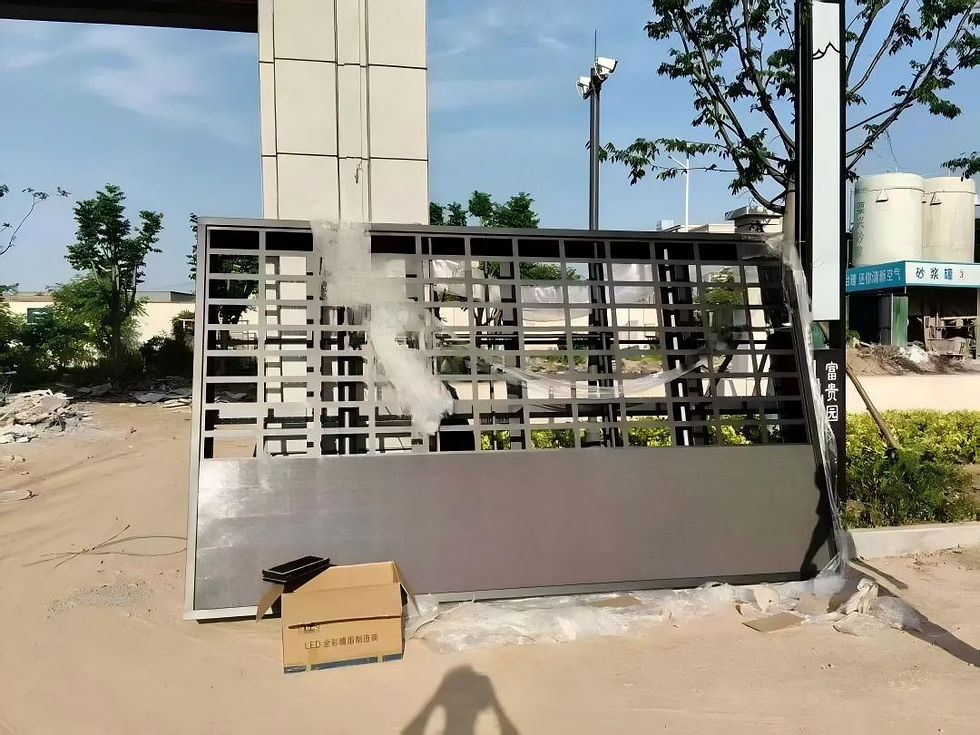
After the on-site inspection was completed, the construction team adjusted the placement angle of the LED cabinet and positioned the screen body sideways for further checking.
Before lifting, the team checked:
Side frame reinforcement
Rear maintenance openings
Reserved service windows
Lifting points
Welding positions
Bolt holes
Connection plates
Screen surface protection
Protective lifting pads
The two independent concrete foundations for the double columns had been poured and cured before the screen arrived. The steel columns were treated with hot-dip galvanizing for corrosion resistance, making them suitable for long-term outdoor use.
Before screen installation, the team confirmed:
Foundation position
Foundation level
Column verticality
Anchor bolt position
Column load-bearing condition
Connection part alignment
Installation safety area
Since the foundations and columns had already passed acceptance, no secondary civil construction was required. The main task was to align the LED display cabinet with the double-column connection parts accurately.
Compared with a single-column LED display, a double-column structure provides more balanced support during lifting. The screen is less likely to tilt or swing sharply, which improves lifting safety and installation accuracy.
Image Caption:The LED display cabinet is positioned and checked before lifting, with reinforced side frames and reserved rear maintenance access.
Alt Text:Outdoor LED display cabinet positioned for double-column lifting installation.
Suggested File Name:led-display-lifting-preparation.jpg
Step 3: Double-Column Fixing and LED Cabinet Installation
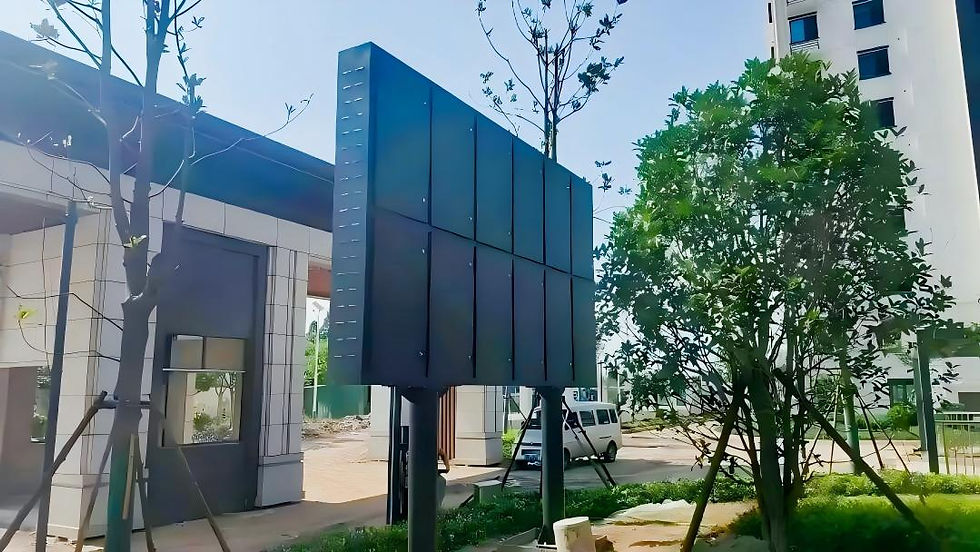
With the help of lifting equipment, the LED display cabinet was raised steadily and aligned with the two black load-bearing columns.
After the screen reached the correct position, workers gradually tightened the fixing bolts and connected the waterproof LED cabinet to the column support frame. The whole screen body was firmly fixed to the double-column structure.
During this process, the team checked:
Screen horizontal alignment
Bolt locking strength
Connection plate position
Structural stability
Rear maintenance space
Cable access position
Ventilation openings
Waterproof sealing areas
From the rear side of the LED display, the modular rear covers, evenly arranged locking screws, reserved cable channels, and heat dissipation openings could be clearly seen.
This step is very important because the structural connection directly affects long-term outdoor safety. Outdoor LED screens need to withstand wind pressure, rain, temperature changes, vibration, and long-term environmental exposure.
If the bolts are not tightened correctly or the connection plates are not accurately aligned, the screen may shake, deform, or create safety risks during long-term use.
Image Caption:Outdoor full-color LED display firmly fixed on a double-column support structure with rear maintenance access and organized cable routing.
Alt Text:Outdoor full-color LED display installed on double-column steel structure.
Suggested File Name:double-column-led-display-installation.jpg
Why Choose a Double-Column Structure for Outdoor LED Displays?
The double-column structure is one of the most practical installation methods for outdoor LED information screens in residential communities and public areas.
It offers strong load-bearing capacity, better wind resistance, sufficient rear maintenance space, wider screen adaptability, and flexible site layout.
Strong Load-Bearing Capacity
Two columns share the screen weight evenly. Compared with a single-column structure, the force distribution is more balanced and less concentrated.
For wider outdoor LED screens, this is especially important. The double-column support structure can reduce stress concentration and improve the overall stability of the display system.
Better Wind Resistance
Outdoor LED displays must withstand long-term wind pressure and weather changes. A double-column structure, combined with independent concrete foundations, provides stronger support against side wind and outdoor vibration.
For residential community entrances, the screen is usually installed in an open outdoor area. Strong structural support helps reduce risks such as screen shaking, column bending, base settlement, and structural deformation.
Easier Rear Maintenance
The double-column structure naturally creates enough space behind the screen. Technicians can access the rear side of the LED display to inspect and maintain the system.
Maintenance work may include:
Replacing LED modules
Checking power supplies
Inspecting receiving cards
Testing signal transmission cables
Organizing internal wiring
Checking waterproof seals
Cleaning ventilation areas
Troubleshooting the LED control system
In many cases, rear maintenance can reduce the need for aerial lifts or scaffolding, helping lower future maintenance time and cost.
Suitable for Wider LED Displays
For a large-width outdoor LED display, a single-column structure may create long cantilever distance, unbalanced force, and higher wind load risk.
A double-column support system holds the display more evenly and keeps the overall appearance stable and balanced. It is more suitable for wider community entrance LED screens, public information displays, and outdoor digital signage projects.
Flexible Installation Layout
A double-column LED display is installed independently on the ground. It does not need to rely on building walls, which helps avoid damage to exterior wall stone, insulation layers, decorative facades, and existing wall structures.
It can be installed in flexible locations, such as:
Main community entrance
Central garden area
Landscape node
Property service zone
Public square
Pedestrian entrance
Community information area
This makes it easier to integrate the LED screen with landscape design, greenery, signage, and community wayfinding systems.
Step 4: Cable Connection, Waterproofing, and Power-On Testing
After the mechanical fixing work was completed, the weak-current construction team connected the power cables and network signal cables.
For outdoor LED display installation, cable connection and waterproof treatment are critical. Poor waterproofing may cause water ingress, corrosion, short circuits, unstable signal transmission, or display failure.
The main work included:
Power cable connection
Network cable connection
Signal transmission check
Waterproof connector treatment
Power distribution inspection
Grounding inspection
LED control system configuration
Resolution setting
Brightness adjustment
Color calibration
Test content playback
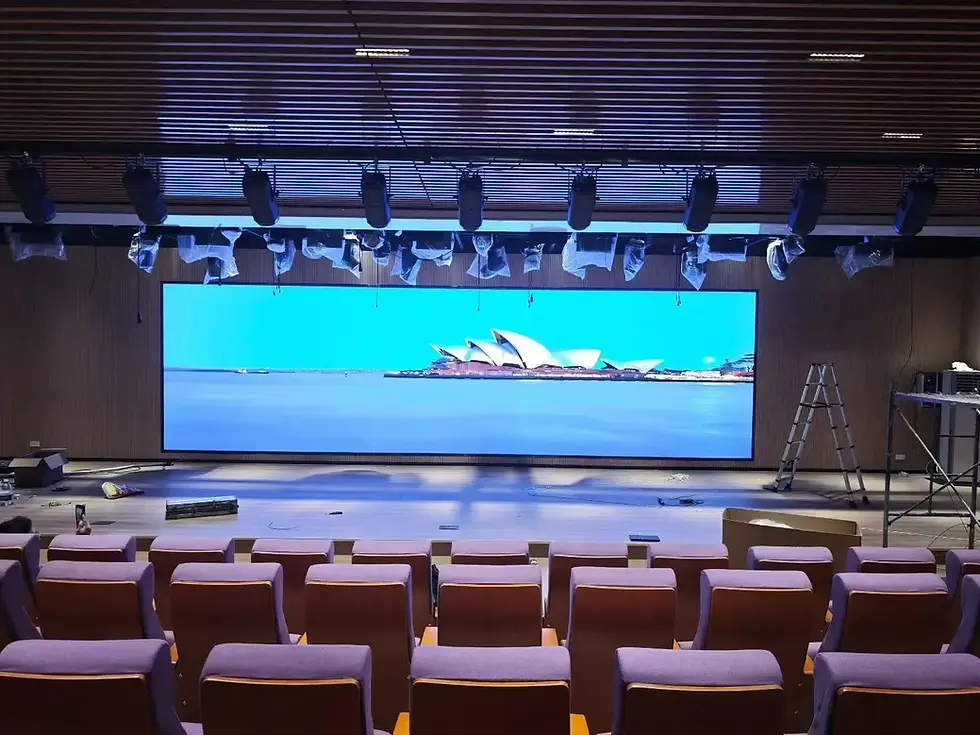
After power-on, the LED display lit up successfully and played landscape test images. The display showed uniform color, stable brightness, no flickering, no abnormal lines, no dark areas, and no obvious dead pixels.
The installation team then completed final cable arrangement, detail reinforcement, and waterproof reinspection.
After the screen passed display testing and structural inspection, the outdoor LED information screen was ready for delivery and daily operation.
Image Caption:The outdoor double-column LED display is successfully powered on and tested, ready for community announcements and property information release.
Alt Text:Outdoor double-column LED display powered on at residential community entrance.
Suggested File Name:community-led-display-power-on-testing.jpg
What Can a Residential Community LED Display Be Used For?
A residential community LED display can support many daily property management and public information functions.
Common applications include:
Community announcements
Property management notices
Public service information
Emergency notifications
Festival greetings
Safety reminders
Weather alerts
Community event updates
Parking information
Visitor guidance
Community image promotion
Public welfare content
Rolling text messages
Video and image playback
For smart community projects, the LED display is not only a screen. It is a digital information release platform that helps property teams reduce printed materials, update information faster, and make community communication more visible.
How to Choose the Right Outdoor LED Display for a Community Project?
Before selecting an outdoor double-column LED display, project owners, contractors, and system integrators should evaluate both display performance and structural requirements.
Important selection factors include:
Installation location
Viewing distance
Screen size
Pixel pitch
Brightness requirement
Waterproof rating
Cabinet material
Maintenance method
Foundation design
Column height
Wind load requirement
Power supply capacity
Signal transmission method
LED control system
Sending card and receiving card compatibility
Video processor requirement
Control software function
Content management method
Maintenance accessibility
For residential community entrances, the screen should be bright enough for outdoor viewing but not too dazzling at night. The structure should be stable, corrosion-resistant, and easy to maintain.
If the property team needs frequent content updates, a network-based control system or cloud publishing software is usually more convenient than USB-only playback.
Key Installation Risks and Quality Control Points
Although a double-column LED display structure is reliable, several risks should still be controlled during installation.
Foundation Quality
The concrete foundation must match the screen size, weight, wind load requirement, and installation height.
If the foundation is too shallow, poorly positioned, or not fully cured, the LED screen may become unstable after installation.
Waterproof Details
Outdoor LED display failures are often related to water ingress. Cabinet sealing, cable joints, power boxes, and rear maintenance doors should be checked carefully.
Waterproof treatment should not only be done during installation but also reviewed during later maintenance.
Cable Management
Power cables and signal cables should be routed neatly and protected from pulling, bending, rainwater accumulation, and mechanical damage.
Poor cable management may cause unstable signal transmission or increase future maintenance difficulty.
Control System Matching
The sending card, receiving card, video processor, control software, and display resolution must match the LED screen configuration.
Incorrect settings may cause display distortion, abnormal color, incomplete image display, or signal instability.
Lifting Safety
The LED display cabinet is large and heavy. Lifting should be carried out by trained personnel using suitable lifting equipment.
The work area should be protected, and the lifting route should be planned in advance to reduce safety risks.
Project Value: From Printed Notice Board to Smart Community Display
Traditional printed notice boards require manual replacement, have limited display space, and cannot show dynamic content.
The double-column LED display installed in Fuguiyuan Residential Community provides a more flexible and modern information release method.
It allows the property management team to publish and update:
Community notices
Public service reminders
Weather information
Safety announcements
Event updates
Festival greetings
Property service content
Emergency messages
Community image videos
The main project values include:
Faster information updates
Less dependence on printed materials
More visible community announcements
Better property management image
Stronger smart community atmosphere
Flexible video, image, and text display
Improved public information delivery
Enhanced entrance landscape effect
As part of the smart community upgrade, the LED display improves both the appearance and digital management level of the
residential community.
FAQ
Can an outdoor LED display be installed in a residential community?
Yes. Outdoor LED displays are commonly used at residential entrances, community squares, property service areas, and public information zones. They can display property notices, public service information, community announcements, event updates, and emergency messages.
Why use a double-column structure for outdoor LED screens?
A double-column structure provides stronger load-bearing capacity, better wind resistance, more balanced force distribution, and easier rear maintenance compared with many single-column installations.
Does an outdoor LED display need waterproof treatment?
Yes. Outdoor LED displays require waterproof LED cabinets, sealed cable connectors, protected power boxes, proper grounding, and regular waterproof inspection to ensure long-term stable operation.
How is content updated on a community LED display?
Content can be updated through LED control software, a media player, network transmission, or cloud-based publishing software, depending on the selected control system.
Is rear maintenance important for outdoor LED displays?
Yes. Rear maintenance allows technicians to inspect LED modules, power supplies, receiving cards, signal cables, waterproof seals, and the LED control system more easily. This helps reduce future maintenance time and cost.
What should be checked before power-on testing?
Before power-on testing, the team should check power cables, signal cables, grounding, waterproof connectors, cabinet fixation, control system settings, receiving card configuration, and screen resolution parameters.
Conclusion
Installing an outdoor double-column full-color LED display for a residential community requires a complete and standardized workflow. The main process includes factory-prefabricated cabinet production, on-site inspection, lifting preparation, double-column fixing, cable connection, waterproof treatment, power-on testing, display calibration, and final delivery.
The Fuguiyuan Residential Community project shows that a prefabricated LED cabinet combined with a double-column steel structure can shorten the on-site construction period, improve installation quality, enhance structural reliability, and make future maintenance easier.
For residential community entrances, property service areas, public squares, and outdoor information zones, the double-column LED display is a practical and reliable solution. It provides strong load-bearing capacity, good wind resistance, convenient rear maintenance, flexible installation layout, and long-term outdoor performance.
As a smart community information platform, the outdoor LED display replaces traditional printed announcement boards and helps property managers release notices, public information, event updates, and emergency messages more efficiently.
A well-designed outdoor double-column LED display not only improves information delivery but also enhances the visual image and digital management level of the residential community.
Call to Action
Need an outdoor LED display solution for a residential community, commercial plaza, school, park, or public information project?
Contact our team for LED screen configuration, double-column structure design, LED control system selection, installation support, and project quotation.

Comments