
COB vs SMD LED Display Installation: Key Differences, Advantages, and Selection Guide
- Tse Cherie
- 1 day ago
- 11 min read

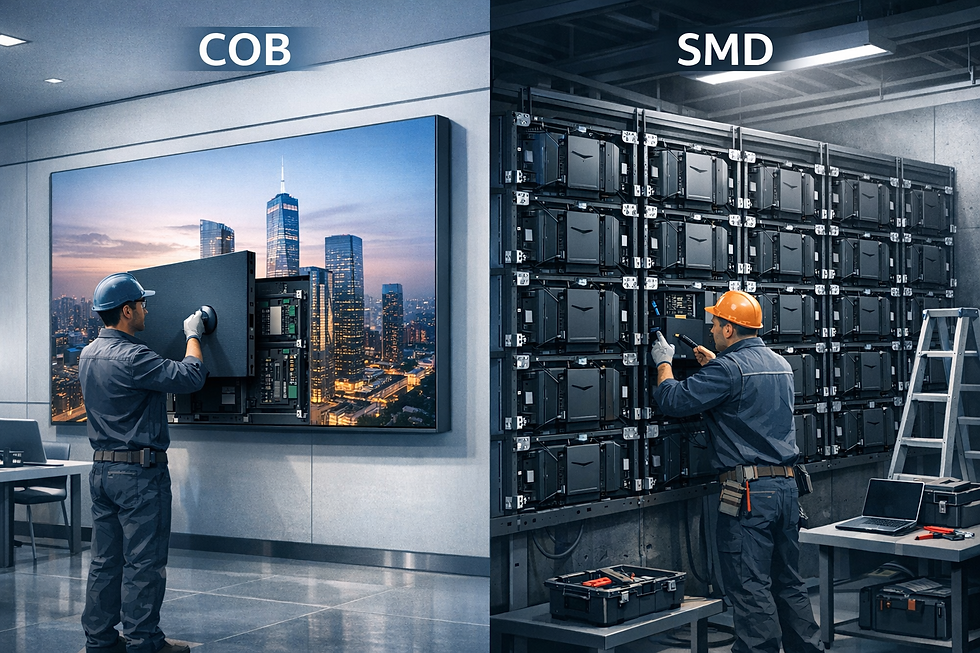
COB vs SMD LED display installation differs mainly because the two technologies use different packaging structures, and that difference affects module design, maintenance access, on-site assembly, structural planning, and long-term service efficiency. In practical LED display projects, the gap between COB and SMD is not only about how the screen looks. It also affects how the system is mounted, how much service space is required, how quickly technicians can complete installation, and how easily the screen can be maintained after delivery.
For engineers, system integrators, procurement teams, distributors, and B2B buyers, this is an important topic because packaging technology influences more than the display surface. It also shapes the cabinet structure, service method, and project execution logic within the wider LED control system. Although both COB and SMD screens work with the same upstream components—such as the video processor, sending card, receiving card, control software, and signal transmission network—their mechanical behavior during installation is quite different.
In simple terms, COB LED displays are usually easier to deploy in fine-pitch, front-maintenance, and space-constrained indoor projects, while SMD LED displays remain widely used in conventional applications where mature supply chains, familiar workflows, and rear maintenance access are acceptable. The sections below explain these differences in a practical, project-oriented way.
1. Overview
COB and SMD are two mainstream packaging technologies used in modern LED display products. Both can be integrated into the same display architecture, both can reproduce video and graphics through the same signal chain, and both can be used in commercial, institutional, and industrial applications. However, they are physically built in different ways, and that is what creates the installation difference.
A COB LED display uses Chip on Board packaging. Instead of mounting separate packaged lamp beads onto the PCB, the LED chips are directly encapsulated on the board. This creates a more integrated display surface and usually gives the module a flatter and more unified structure.
An SMD LED display uses Surface-Mounted Device packaging. In this structure, individually packaged LED lamp beads are soldered onto the PCB to form the final display module. This is a mature and widely adopted process across a large portion of the LED display market.
The engineering impact of this structural difference is significant. It affects:
how modules are handled on site,
how cabinets are aligned and fixed,
whether front maintenance is practical,
how much rear service space is needed,
and how future repair work is carried out.
That is why the installation discussion around COB and SMD is not just about assembly convenience. It is about how packaging technology influences the full project lifecycle.
2. COB vs SMD LED Display: Quick Comparison
Before going deeper into system logic and installation details, it helps to compare the two technologies at a glance.
Item | COB LED Display | SMD LED Display |
Packaging Structure | LED chips directly encapsulated on PCB | Individually packaged LED lamp beads soldered on PCB |
Surface Condition | More integrated and flatter | Discrete lamp structure |
Installation Logic | More modular and simplified in many projects | More dependent on precise module alignment |
Maintenance Method | Often front maintenance | Commonly rear maintenance |
Space Requirement | Suitable for close-to-wall installation | Usually requires rear service space |
Typical Use | Fine-pitch indoor displays, premium interiors, control rooms | Conventional indoor and outdoor displays, general commercial projects |
On-Site Adjustment | Usually fewer delicate exposed elements | More attention to flatness, seams, and alignment |
Service Convenience | Better suited to limited-space maintenance | More dependent on structural service access |
This comparison does not mean COB is always the better option. It means each technology has a different engineering logic. The right choice depends on project environment, service strategy, and budget structure.
3. Functional Positioning in the LED Display System
COB and SMD are display-side packaging technologies, not control devices. They do not replace a sending card, receiving card, or video processor, nor do they directly perform signal decoding or image scaling. Their role is to determine how the pixel is physically packaged and how the screen behaves mechanically and structurally after installation.
In a typical LED display project, the overall system usually includes:
a content source,
a video processor or LED controller,
a sending card for outputting display data,
a signal transmission path,
a receiving card inside the cabinet,
a module drive structure,
power supply units,
and control software for setup, calibration, and monitoring.
Within this chain, COB and SMD sit at the final display layer. Their packaging form affects the relationship between the module and the cabinet, the cabinet and the structure, and the installer and the service process. In practical terms, this means the packaging route may influence:
cabinet communication layout,
front or rear maintenance design,
the way the receiving card area is accessed,
assembly precision on site,
protective performance of the display surface,
and maintenance workflow over time.
So while COB and SMD do not change the upstream signal transmission logic, they do change how the system is physically deployed and maintained. This is why the packaging decision should be treated as part of the total system design rather than as an isolated product feature.
4. Working Principles and Installation Logic
At the electronic level, COB and SMD displays work through the same broad signal chain. Content is processed, transmitted, decoded, and displayed through controlled LED output. The difference lies in how the display pixels are physically formed and how that affects construction behavior on site.
4.1 Common Signal and Control Workflow
Most LED displays follow a standard operating path:
A computer, media server, broadcast source, or playback device provides content.
A video processor scales, switches, or reformats the image.
A sending card converts the processed content into display control data.
The data is delivered through wired signal transmission paths.
A receiving card inside each cabinet receives the data and distributes it to the module.
The driver circuitry controls the LED output to reproduce the image.
Control software is used for screen mapping, brightness settings, color adjustment, diagnostics, and system management.
This workflow applies to both COB and SMD displays. In other words, their upstream control logic is broadly the same. They can both work with conventional LED control system architecture and mainstream display control methods.
4.2 How COB Packaging Changes Installation Logic
In a COB display, the LED chips are directly encapsulated on the PCB. Because there are no separately mounted exposed lamp beads in the same conventional sense, the display surface is more consolidated. From an engineering perspective, this creates a more integrated module form.
This often changes installation logic in several ways:
the module surface is generally less vulnerable during handling,
the installation process can involve fewer delicate exposure risks,
front-service structure is easier to implement in many indoor products,
the screen can often be mounted close to a wall without sacrificing future service access.
For the installer, this can simplify project execution, especially in fine-pitch indoor applications. Instead of relying heavily on rear access and extensive on-site service channels, the project can be designed around front maintenance and tighter architectural integration.

4.3 Why SMD Screens Require More Precise On-Site Assembly
In an SMD display, the LEDs are packaged as individual lamp beads and then soldered onto the PCB. This structure is proven and widely used, but from an installation perspective it tends to require more detailed alignment work.
In practical construction, SMD screens often involve:
repeated module positioning,
seam alignment,
flatness adjustment,
point-by-point fixation,
and careful attention during assembly and maintenance.
For many projects, especially standard commercial screens, this is not a problem because installers are already familiar with the workflow. However, in fine-pitch environments or installations with limited service space, the need for rear access and precise on-site handling can increase construction difficulty.
5. Product Classification
COB and SMD LED displays can be classified in several useful ways for project planning and procurement.
5.1 Classification by Packaging Technology
This is the most direct classification:
COB LED display
SMD LED display
This classification matters because it affects both mechanical structure and maintenance logic.
5.2 Classification by Maintenance Method
From a service perspective, LED displays are commonly divided into:
front-maintenance displays
rear-maintenance displays
front and rear maintenance displays
COB is frequently associated with full front maintenance, especially in indoor fine-pitch scenarios. SMD can also be designed for front access in some products, but rear maintenance is still common across a large part of the market.
5.3 Classification by Application Environment
LED displays can also be grouped by application:
indoor fixed installation,
outdoor fixed installation,
control room display,
conference room display,
retail display,
transportation information display,
rental display,
studio and broadcast display.
COB is more commonly discussed in indoor, fine-pitch, and premium integration scenarios. SMD remains common across both indoor and outdoor projects due to its mature manufacturing base and wider market coverage.
5.4 Classification by Pixel Pitch
Common pitch-related categories include:
ultra-fine pitch,
fine-pitch indoor display,
standard indoor display,
conventional outdoor pitch display.
COB is often considered in smaller-pitch applications where surface consistency and protection are important. SMD remains widely used across a broad range of pixel pitches and project budgets.
6. Typical Applications
The installation difference between COB and SMD becomes much clearer when viewed through actual project use cases.
6.1 Fine-Pitch Indoor LED Displays
Fine-pitch indoor applications are one of the strongest use cases for COB. These include:
boardrooms,
conference rooms,
executive briefing spaces,
exhibition halls,
premium retail environments,
and high-end brand interiors.
These projects often require close viewing distance, clean wall integration, and minimal structural depth. Since many COB solutions support front maintenance, they fit well in spaces where rear access is difficult or visually undesirable.
6.2 Control Rooms and Monitoring Centers
In control rooms, uptime, service efficiency, and long-term operational stability are important. If a display is mounted into a wall or integrated into a monitoring environment with limited rear clearance, COB can offer practical service advantages.
SMD is also used in control room applications, especially where procurement standards are already based on mature SMD solutions or where budget structure is more sensitive. However, the maintenance method should be reviewed carefully at the design stage.
6.3 Commercial Indoor Projects
SMD remains very common in:
shopping malls,
schools and universities,
meeting halls,
hotel function spaces,
public lobbies,
transportation facilities.
These projects often have enough structural depth or built-in service access to support rear maintenance. In such cases, SMD remains a practical and widely available solution.
6.4 Outdoor and Conventional Large Screens
For outdoor and standard large-format commercial installations, SMD is still widely adopted. This is partly because the technology is mature and partly because many outdoor structures already allow sufficient rear access for maintenance.
In these scenarios, the project may prioritize established product availability, conventional cabinet design, and familiar technician workflows over the specific structural benefits offered by COB.
6.5 Space-Constrained Installation Scenarios
When the project involves:
close-to-wall mounting,
embedded construction,
narrow indoor spaces,
or architectural environments with limited service clearance,
COB usually has an engineering advantage. In these situations, front maintenance is not just a convenience. It can be a key condition for whether the display remains serviceable after installation.
7. Advantages of COB and SMD LED Displays
A balanced comparison should explain where each technology performs well rather than presenting one as universally preferable.
7.1 COB Installation Advantages
Higher integrationCOB modules are generally more integrated at the packaging level, which can reduce the number of delicate exposed elements during installation.
Simpler installation workflowBecause the module structure is often more complete, some projects involve fewer on-site adjustment steps and a cleaner assembly process.
Front maintenance suitabilityThis is one of COB’s most important engineering advantages. In many products, modules and key components can be serviced from the front side.
Better fit for limited-space projectsCOB is well suited to wall-mounted and interior-integrated applications where rear maintenance channels are difficult to provide.
Improved surface consistencyThe display surface is typically flatter and more unified, which can help reduce accidental touch-related issues in some indoor applications.
7.2 SMD Installation Advantages
Mature industry ecosystemSMD is one of the most established technologies in the LED display market, with broad supply chain support and extensive field experience.
Wide product availabilitySMD products are available in many pitch ranges, cabinet formats, and application categories.
Strong installer familiarityMost integrators and technical teams are already familiar with SMD assembly, adjustment, and maintenance routines.
Broad application flexibilitySMD is used in indoor, outdoor, fixed-installation, and rental environments, making it a versatile option across many project types.
8. Limitations and Engineering Considerations

The right technical choice requires understanding limitations as well as advantages.
8.1 COB Limitations
Higher initial cost in some segmentsDepending on pitch, brand, and configuration, COB can involve a higher upfront investment than mainstream SMD products.
Not necessary for every installationIf the project is a conventional screen with enough rear maintenance space, the structural benefits of COB may not justify the extra cost.
Maintenance results still depend on cabinet designAlthough COB is commonly linked to front maintenance, actual service convenience depends on the complete product design, not the packaging term alone.
Supplier options may varyCompared with SMD, the available product range may be narrower in some categories or regional markets.
8.2 SMD Limitations
More detail-sensitive installationSMD often requires tighter control over seams, alignment, and surface flatness during assembly.
Rear access is often still requiredFor many products, maintenance planning must include enough space behind the screen.
More exposed pixel structureIn fine-pitch applications, exposed lamp-bead construction can be more sensitive during transport, installation, and later service.
Less suitable for very tight service environmentsIf the display is installed against a wall or inside a narrow structural cavity, maintenance can become difficult and expensive.
9. How to Choose Between COB and SMD
Selection should be based on engineering conditions, operating priorities, and long-term maintenance logic rather than on packaging trend alone.
9.1 Evaluate the Installation Environment
Start with the physical site:
Will the screen be mounted close to a wall?
Is rear maintenance space available?
Is the structure recessed or architecturally integrated?
Is there enough depth for future access?
If rear access is limited, COB often becomes a stronger candidate.
9.2 Review Maintenance Access
Maintenance planning should be discussed early, not after installation. Key questions include:
Is front maintenance required?
How will modules be replaced?
How easily can technicians reach the power supply and receiving card area?
What happens if a module fails after installation?
For long-term fixed installations, service convenience can have a major effect on operating cost.
9.3 Check System Compatibility
Even though COB and SMD are packaging technologies, they still need to fit smoothly into the total LED control system. Buyers should confirm:
compatibility with the sending card,
integration with the receiving card layout,
support within the chosen control software,
coordination with the video processor,
cabinet communication method,
power and signal interface design,
and the reliability of overall signal transmission.
This is particularly important for projects that use standardized control platforms or existing signal distribution architecture.
9.4 Compare Budget and Lifecycle Cost
Initial purchase price is only one part of project cost. A more complete cost view should include:
installation labor,
wall clearance and service corridor design,
mounting structure,
maintenance downtime,
spare part replacement,
and long-term service efficiency.
In some cases, SMD may cost less at the beginning but require more structural accommodation and maintenance effort later. COB may cost more upfront but reduce service limitations over the project lifecycle.
9.5 Assess Reliability and Supplier Support
Before making a procurement decision, buyers should ask:
How stable is product supply?
What is the spare module policy?
How quickly can components be replaced on site?
What documentation is provided for setup and maintenance?
Is technical support available for system integration?
These questions are often more useful than broad product claims.
10. Common Brand Types in the Market
The COB and SMD display market includes several types of suppliers, and buyers should evaluate them according to project fit rather than simple visibility.
10.1 Full-System LED Display Manufacturers
These companies typically offer complete display solutions, including cabinets, modules, structure coordination, and compatibility with mainstream control platforms. They may provide both COB and SMD options.
10.2 Fine-Pitch and Premium Solution Providers
Some suppliers focus on fine-pitch indoor projects, conference systems, control rooms, and high-end commercial environments. COB products are often more visible in this category.
10.3 Volume-Oriented and Channel-Focused Suppliers
Other suppliers compete through broad standardization, large-scale production, and flexible pricing. SMD products are especially common in these channels.
10.4 What Buyers Should Compare
Rather than choosing based on brand name alone, B2B buyers should compare:
cabinet precision,
maintenance design maturity,
compatibility with the sending card and receiving card platform,
support for control software configuration,
reliability of signal transmission,
spare parts continuity,
project support capability,
and after-sales response.
This approach is usually more practical than relying on marketing language.
11. Conclusion
The installation differences between COB and SMD LED displays come directly from their packaging structure, and those structural differences influence how the screen is assembled, accessed, serviced, and managed over time. COB LED displays use a more integrated chip-level packaging method, which often supports front maintenance, simpler installation logic, and better suitability for fine-pitch indoor or space-constrained projects. SMD LED displays use individually packaged lamp beads, offering a mature and widely available solution that remains practical across many conventional indoor and outdoor applications.
For engineers, integrators, procurement teams, and distributors, the right choice depends on more than display appearance. It should be evaluated in the context of the full LED control system, including the video processor, sending card, receiving card, control software, cabinet communication structure, and signal transmission plan.
In practical terms:
choose COB when the project requires fine pitch, front maintenance, close-to-wall installation, or tighter architectural integration;
choose SMD when the project has adequate rear service space, standardized installation workflow, and broader cost sensitivity.
The most effective solution is the one that matches packaging technology with project conditions, maintenance strategy, and long-term service requirements.


Comments