
Understanding LED Display Viewing Angle: A Complete Guide to Factors, Performance, and Selection
- Tse Cherie
- 1 day ago
- 16 min read

LED display viewing angle is the range within which an LED screen can maintain acceptable brightness, color consistency, and contrast when viewed away from the centerline. In practical terms, it determines how well the image performs for people standing to the side, sitting off-center, or viewing from higher or lower positions. In an LED display system, viewing angle is not a single isolated specification. It is the combined result of LED packaging, optical structure, module design, assembly precision, calibration strategy, and installation conditions. For engineers, system integrators, procurement teams, distributors, and other B2B buyers, understanding LED display viewing angle matters because it directly affects audience coverage, image uniformity, application suitability, and overall project value.

1. Overview
LED display viewing angle refers to the angle between the viewer’s line of sight and the normal line perpendicular to the screen surface. It is usually described in two dimensions:
Horizontal viewing angle
Vertical viewing angle
This distinction matters because many LED displays do not behave equally in both directions. Some products are designed for balanced viewing, while others intentionally use wider horizontal coverage and narrower vertical coverage to optimize front brightness, reduce wasted light, or better match the intended installation environment.
In the LED display industry, the most common way to define viewing angle is the point at which front brightness drops by 50 percent. This is often called the half-power angle. However, some higher-end manufacturers and more demanding projects also use stricter standards, such as the point at which contrast falls to 10:1. These two methods can produce different results for the same screen.
For that reason, viewing angle should not be judged by the parameter value alone. A display labeled 160∘×140∘160^\circ \times 140^\circ160∘×140∘ may offer a very different side-view experience from another display with the same nominal value if the testing method, LED package structure, optical design, or side-view color consistency is different. In real projects, the effective viewing angle depends less on the printed specification and more on whether brightness, contrast, color, and grayscale remain usable across actual audience positions.
2. Functional Positioning
Within the broader LED control system, viewing angle is not an electronic control function in the same way as a sending card, receiving card, or video processor. Instead, it belongs to the optical performance layer of the display. If the control system determines how image data is transmitted, processed, mapped, and displayed, then viewing angle determines how consistently that final image can be seen from different positions in the real environment.
Its role in an LED display project can be understood in several ways.
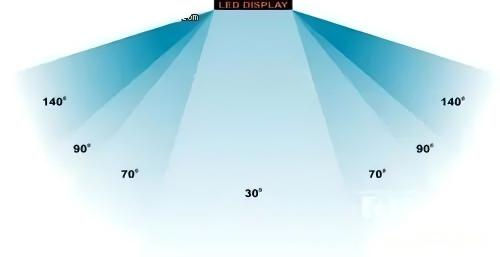
To better illustrate this concept, the diagram below provides a simplified view of how LED display visibility changes as the viewing position moves away from the screen center.
2.1 Audience coverage
Viewing angle determines whether people located at the sides, lower floors, upper levels, or other off-axis positions can still see the content with acceptable quality. This makes it a direct factor in the screen’s practical service area.
2.2 Visual consistency
The real value of viewing angle is not simply extending how far a viewer can move away from center. It is preserving usable image quality in those positions. If side viewers experience severe brightness drop, color shift, or low contrast, then the nominal angle value has limited practical meaning.
2.3 Application matching
Different applications have very different audience geometries. A conference room display, a roadside billboard, a rental stage screen, and a control room wall do not need the same angle strategy. Viewing angle therefore serves as an application-matching parameter rather than a universal “the larger the better” metric.
2.4 System-level design input
Viewing angle is also tied to cabinet structure, mask design, screen tilt, mounting height, ambient light adaptation, and calibration strategy. In this sense, it is part of total display system design rather than only a lamp-level specification.
3. Working Principles
The working principle behind LED display viewing angle is fundamentally optical. Each LED pixel emits light according to a specific spatial distribution, and the final visible angle depends on how this light is shaped, blocked, diffused, reflected, or compensated throughout the display structure.
3.1 Light emission from the LED package
At the most basic level, the LED chip and package determine the original light emission pattern. Different package structures create different optical behaviors. If the package introduces physical blockage, unequal RGB emission at oblique angles, or directional limitations, the practical viewing angle may narrow or become less uniform.
3.2 Optical shaping at module level
After leaving the LED package, the light is further affected by the optical design of the module. Important factors include:
lens structure
mask opening geometry
lamp cup shape
black surface coating
matte or glossy surface treatment
These elements determine whether the light is broadly distributed, concentrated toward the front, or shaped asymmetrically. For example, some outdoor displays intentionally use wider horizontal coverage and narrower vertical distribution to improve useful front brightness and reduce inefficient light spill.
3.3 Pixel interaction and visual blending
Viewing angle is not only about a single LED point. It also depends on how neighboring pixels blend visually when observed from the side. Smaller pixel pitch generally improves side-view uniformity because the visual gap between pixels becomes less noticeable, allowing the image to remain more coherent at oblique viewing positions.
3.4 Mechanical alignment and cabinet flatness
Even with good optical design, poor mechanical precision can reduce practical viewing angle. Uneven lamp height, cabinet deformation, module misalignment, and visible seams can cause shadowing, light blockage, or localized brightness inconsistency. In large screens, this can significantly affect edge-position viewing quality.
3.5 Electronic compensation and control logic
The receiving card, driver IC, and control software do not physically extend the hardware viewing angle, but they can optimize the visible result within the hardware limit. Common electronic optimization methods include:
multi-angle color calibration
side-view brightness compensation
grayscale tuning
RGB current adjustment for off-axis viewing
In this relationship, the hardware sets the upper limit, while software improves the usable visual performance within that limit. The sending card and video processor ensure the correct signal path and image processing, but the final off-axis viewing result still depends heavily on the optical chain from LED package to audience.
4. Product Classification
LED display viewing angle can be classified according to the technologies and design approaches that affect it in practice.
4.1 By LED packaging type
SMD LED
SMD remains one of the most widely used package types in the industry. It generally provides horizontal viewing angles in the range of about 120∘120^\circ120∘ to 160∘160^\circ160∘, with vertical angle often somewhat narrower. It is widely used because of its mature supply chain, balanced cost, and broad compatibility across indoor and outdoor products.
COB LED
COB reduces some of the structural limitations seen in traditional packaged devices and often improves viewing consistency, especially for fine-pitch indoor displays. It is commonly used in higher-end applications where side-view image quality and surface robustness matter.
Flip-chip COB
Flip-chip COB reduces wire-related optical obstruction and can improve light distribution consistency. In high-end implementations, it may support broader and more stable off-axis performance with better RGB balance.
Mini LED / Micro LED
These advanced technologies enable finer optical control and more precise light distribution. They are mainly used in premium small-pitch applications where image quality, side-view consistency, and high-end visual performance are critical.
4.2 By optical distribution design
Symmetrical wide-angle design
This approach is used when both left-right and up-down audience coverage are important. It is common in conference rooms, retail spaces, exhibition halls, and many indoor commercial displays.
Asymmetrical optical design
This is often used in outdoor screens or project-specific installations. A display may use wider horizontal coverage and narrower vertical coverage to increase effective front brightness, reduce wasted light, and better match real audience distribution.
4.3 By surface and mask structure
Deep mask / black cup design
This structure usually improves contrast by reducing ambient reflection, but it may narrow the usable viewing angle.
Shallow mask / reflective geometry
This can help widen the angle, but it may reduce contrast under strong environmental light.
Matte surface treatment
A matte or diffused surface can improve off-axis consistency by softening reflections and stabilizing side-view perception, although it may slightly reduce peak front brightness.
4.4 By application-oriented performance class
In commercial practice, viewing angle is also often understood by application type, such as:
standard commercial displays
wide-angle rental displays
high-uniformity conference displays
high-brightness outdoor advertising displays
high-contrast monitoring and control room displays
For many buyers, this application-based classification is more useful than package type alone because it aligns optical performance with project needs.
5. Applications
Viewing angle requirements differ significantly by application, and correct selection depends on understanding how audiences are distributed around the screen.
5.1 Outdoor advertising screens
Outdoor billboards often need wide horizontal coverage because traffic and pedestrian flows approach from multiple directions. Vertical angle can also matter when viewers are at different distances or elevations. These projects usually prioritize broad audience reach and readability rather than extreme close-up precision.
5.2 Conference room and command center displays
In meeting rooms and operation centers, viewers are relatively organized, but side seating still matters. A stable horizontal viewing angle helps participants at the far left and right see similar image quality. Vertical angle requirements may be moderate or more demanding depending on screen height and room layout.
5.3 Rental and stage displays
Rental LED screens often face broad audience distributions in fan-shaped layouts. Since viewers may be spread across wide left-right positions and different elevations, both horizontal and vertical viewing performance are important, especially for elevated stage installations.
5.4 High-end retail and showroom displays
Retail and exhibition audiences often move freely and view the display from close range and multiple directions. In these environments, color consistency and contrast stability at side angles are often more important than a high nominal angle number alone.
5.5 Monitoring rooms and indoor operation centers
In control rooms and similar environments, audience positions are often more concentrated toward the front. This allows system designers to accept a more moderate viewing angle if doing so improves contrast, resolution, or overall system cost efficiency.
6. Advantages
A properly selected LED display viewing angle brings clear practical benefits to both system design and end-user experience. It affects not only how many people can see the screen, but also how consistently the content is perceived across different positions in the space. In many projects, especially those involving public viewing or distributed seating, viewing angle is one of the most important factors behind real-world display usability.
6.1 Better audience coverage
A wider and more effective viewing angle allows more viewers to see the content clearly without needing to stand or sit directly in front of the display. This is particularly valuable in outdoor advertising, transportation hubs, stage events, retail environments, and large meeting spaces where the audience is spread across different directions. Better coverage means the screen can serve a broader viewing area with fewer blind spots.
6.2 More consistent visual experience
Good viewing angle performance helps reduce side-view brightness loss, color shift, grayscale distortion, and contrast drop. This creates a more uniform image impression for viewers located at the center and at the edges of the audience area. In practical deployments, this consistency often matters more than the nominal angle number itself, because users judge the screen by what they actually see rather than by the specification sheet.
6.3 Improved application fit
Matching viewing angle performance to audience geometry helps optimize the display for the intended application. For example, a conference room may need stable horizontal coverage for side seating, while a rental stage screen may require broad horizontal and vertical visibility for wide fan-shaped audience zones. Proper angle selection allows the screen to support the actual project environment rather than relying on generalized specifications.
6.4 Reduced complaint risk in real projects
In B2B projects, dissatisfaction often comes not from center viewers but from people at edge positions, elevated seats, or off-axis locations. A suitable viewing angle helps reduce this risk during installation acceptance and long-term operation. For integrators and contractors, this can improve project delivery quality and lower the chance of disputes related to visible unevenness or limited viewing coverage.
6.5 Better value when matched correctly
Not every project needs the widest possible viewing angle. Choosing the right angle for the scenario can improve cost efficiency by balancing brightness, contrast, pixel pitch, optical design, and control requirements. In this sense, good viewing angle selection is not only a visual decision but also a practical budgeting strategy that supports better overall system value.
7. Limitations
Although viewing angle is a critical parameter in LED display design, it should not be treated as a standalone indicator of overall image quality. Like many optical specifications, it involves trade-offs, testing differences, and real-world constraints. A balanced evaluation requires understanding what viewing angle can improve and where its limitations begin.
7.1 A larger angle is not always better
Extremely wide-angle designs may reduce front brightness, weaken contrast, or increase product complexity and cost. In some applications, especially those with fixed viewing positions, a narrower but better-controlled angle may produce a stronger front-view image and a more efficient use of light output. The best solution is therefore application-driven rather than purely parameter-driven.
7.2 Datasheet angles may not tell the full story
Two screens with the same viewing angle specification can behave very differently if they use different testing standards, package structures, lens designs, or calibration strategies. One product may maintain better color consistency at side angles, while another may only preserve basic brightness. For this reason, angle specifications should always be reviewed together with the test method and with real visual performance.
7.3 Optical trade-offs are unavoidable
There is often a balance between viewing angle, front brightness, contrast, ambient light resistance, and energy efficiency. Improving one area may weaken another. For example, a structure designed to widen the angle may spread light more broadly and reduce forward intensity, while a deeper mask that improves contrast may also narrow the usable angle. These trade-offs are normal and must be managed at the design stage.
7.4 Software cannot overcome hardware limits
Calibration tools, control software, receiving card adjustment, and driver optimization can improve side-view appearance to some extent, but they cannot truly extend the physical emission pattern beyond the limits of the LED package and optical structure. Software can optimize the usable result, but it cannot replace good hardware design.
7.5 Installation can reduce actual performance
Even a well-designed product may underperform if screen tilt, mounting height, cabinet flatness, or structural rigidity are not properly controlled. Uneven module alignment, cabinet deformation, and poor mechanical installation can all reduce the effective viewing angle in real use. This is why optical performance must be evaluated together with structural quality and installation execution.
8. Selection Guide
Selecting the right LED display viewing angle requires more than checking a single specification in a product datasheet. In actual projects, the correct choice depends on audience distribution, installation geometry, optical design, control capability, and long-term operating conditions. For engineers, system integrators, procurement teams, and channel partners, a useful selection process should connect optical performance with application requirements rather than relying on broad marketing claims.

8.1 Start with audience geometry, not catalog numbers
The first step is to map where viewers will actually stand, walk, or sit. This includes:
left and right offset from screen center
vertical height difference between the screen and the audience
nearest and farthest viewing distances
screen mounting height
screen tilt angle
whether the audience is fixed, moving, or widely dispersed
Once these positions are known, the project team can estimate the maximum off-axis viewing angle relative to the screen normal. This is much more meaningful than choosing a product simply because it lists a larger number. In practice, a screen only needs to cover all real audience points with reasonable margin. Anything beyond that should be evaluated against cost and overall system priorities.
8.2 Confirm the viewing angle test standard
One of the most common purchasing mistakes is comparing angle specifications from different suppliers without checking how those numbers were obtained. Ask whether the published viewing angle is based on:
front brightness falling to 50 percent
contrast dropping to 10:1
internal laboratory method
third-party testing method
full-screen white measurement or mixed-image condition
This matters because two products can both claim the same angle while producing noticeably different side-view results in real use. For procurement and technical evaluation, the test benchmark is often as important as the angle value itself.
8.3 Match package technology to the project level
Different LED package structures provide different practical viewing behavior.
SMD is suitable for many mainstream indoor and outdoor applications where cost balance and mature supply are important.
COB is often preferred for finer-pitch indoor projects where side-view consistency, durability, and optical uniformity matter more.
Flip-chip COB and more advanced structures may be suitable for premium applications requiring improved side-view performance and stronger RGB consistency.
Mini LED or similar high-end solutions are more relevant in projects where image quality expectations are very high and budget flexibility exists.
The package type should be considered together with pitch, brightness, environment, and service requirements rather than in isolation.
8.4 Evaluate module optical design, not just the LED lamp type
Many buyers focus heavily on the LED package while overlooking the optical structure of the module. In reality, module design can significantly change real viewing performance, even when the same package type is used. Important points to review include:
lens configuration
whether the optical distribution is symmetrical or asymmetrical
mask opening depth
lamp cup geometry
black coating and anti-reflection treatment
matte or glossy surface behavior
For example, an outdoor screen may intentionally use a wide horizontal angle with a narrower vertical angle to improve front brightness and reduce wasted upward light. A conference display, by contrast, may prioritize balanced horizontal and vertical consistency.
8.5 Consider pixel pitch and visual blending
Pixel pitch affects not only resolution and viewing distance, but also side-view visual coherence. Smaller pixel pitches usually provide better visual blending at off-axis positions because the spacing between pixels is reduced. This makes the image appear more uniform from the side. Larger-pitch screens may still have a strong nominal angle specification, but their practical side-view image can feel less consistent due to visible pixel separation and reduced blending.
For close-viewing applications such as boardrooms, showrooms, studios, and premium retail, this factor deserves special attention.
8.6 Review compatibility with the LED control system
Although viewing angle is primarily determined by hardware optics, the final visible result is still influenced by the rest of the LED control system. A screen with good optical potential can underperform if the control chain does not support stable calibration or grayscale management. Buyers should confirm whether the system supports:
reliable sending card and receiving card communication
stable cabinet communication
multi-angle calibration capability
fine brightness and color correction
proper grayscale handling at low brightness
integration with the selected video processor
compatible control software for maintenance and adjustment
This is especially important in projects that require high image consistency across large screen areas or complex cabinet layouts.
8.7 Assess reliability and long-term stability
Viewing angle should not be evaluated only on day one. Long-term performance depends on structural precision and thermal stability. Ask whether the product design includes:
good cabinet flatness control
stable module mounting
rigid cabinet materials
effective heat dissipation
resistance to deformation over time
precise lamp alignment and assembly tolerance
If the cabinet gradually warps, if modules shift, or if heat causes structural instability, the practical viewing angle may degrade even if the original optical design was sound. In this sense, reliability and viewing angle stability are closely linked.
8.8 Align viewing angle with brightness and contrast goals
A wider angle is valuable only if the screen remains visually useful under the actual ambient conditions. In high-brightness outdoor environments, contrast retention and front intensity may be more important than maximizing angle width. In indoor premium spaces, side-view color consistency may take priority. This means angle selection must be coordinated with:
target brightness
ambient light conditions
contrast requirements
black level expectations
energy consumption limits
The correct solution is usually a balanced optical strategy rather than the widest possible distribution.
8.9 Check installation conditions before final selection
Installation geometry can strongly affect whether the selected viewing angle works as expected. Review:
wall-mounted versus hanging installation
screen tilt and orientation
audience elevation relative to the screen
architectural obstructions
maintenance space and access
actual site dimensions
For example, an indoor display often benefits from a slight downward tilt, while some outdoor roadside screens may require upward adjustment depending on traffic flow and viewing distance. Even a technically suitable screen can deliver poor practical performance if the installation angle is not aligned with audience sightlines.
8.10 Request visual validation, not just specification sheets
For higher-value projects, it is wise to ask for one or more of the following:
real project case references
side-view photos or videos
demonstrations at different horizontal and vertical angles
sample module evaluation
third-party test reports
on-site mock-up when project scale justifies it
This helps bridge the gap between theoretical specifications and actual viewing experience. In many procurement decisions, visual evidence is more useful than a single claimed viewing angle figure.
8.11 Balance procurement value, not only optical maximum
For buyers and distributors, the objective is not simply to select the display with the largest published viewing angle. The real goal is to choose a product that covers all audience positions reliably while maintaining acceptable brightness, contrast, color consistency, system compatibility, and long-term stability. If a wider-angle design increases cost but does not improve practical project performance, it may not be the best commercial choice.
A strong selection decision therefore combines technical fit, application coverage, and lifecycle value. In most professional LED display projects, this approach produces better outcomes than choosing by headline specifications alone.
9. Brands
The market approaches LED display viewing angle through both finished display brands and upstream component ecosystems. Because viewing angle is the result of packaging, optics, structure, and calibration working together, brand evaluation should remain technical and application-oriented rather than based only on promotional claims.
9.1 Display manufacturers
Many LED display manufacturers highlight wide viewing angle in their indoor fine-pitch, rental, and high-end outdoor product lines. However, actual performance depends on implementation details such as package source, module optical design, cabinet precision, and calibration quality. For that reason, buyers should compare real side-view image consistency rather than relying only on datasheet values.
9.2 LED package and component suppliers
A large part of practical viewing-angle performance is determined upstream by the LED package, optical materials, and surface structure. This means that evaluating a display brand also requires attention to the component path behind the product, especially in projects where fine pitch, premium image quality, or long-term consistency are important.
9.3 Control system ecosystem brands
Established LED control system suppliers do not directly define the physical viewing angle, but they can affect the final visual result through calibration tools, grayscale optimization, and image consistency management. In projects requiring strict uniformity, the interaction between optical hardware and the signal chain—including sending card, receiving card, video processor, and control software—can noticeably influence the perceived performance at side angles.
9.4 How to evaluate brands objectively
A neutral brand evaluation method should include:
published viewing-angle test standard
real project references in similar scenarios
side-view brightness and color consistency
module optical design transparency
calibration capability
after-sales service and technical support
For professional buyers, the most useful brand comparison is not who claims the biggest number, but who can provide the most reliable and verifiable viewing performance for the target application.
10. Conclusion
LED display viewing angle is the practical measure of how well an LED screen serves real viewers outside the center position. It is shaped by LED packaging, module optics, mask structure, surface treatment, pixel pitch, cabinet precision, calibration logic, and installation conditions. In other words, it is neither a simple lamp parameter nor a purely software-driven feature. It is a system-level optical result.
For engineers and system integrators, the key is to evaluate viewing angle in relation to audience geometry and the overall LED display system. For procurement teams, distributors, and B2B buyers, the most important point is that angle specifications must be interpreted together with testing standards, image consistency, brightness strategy, and actual project conditions. A wider number on paper does not automatically mean a better display in practice.
In most real-world projects, the right choice is the one that covers all intended viewing positions with sufficient margin while maintaining acceptable brightness, contrast, and color uniformity. When selected this way, LED display viewing angle becomes more than a specification. It becomes a practical tool for better design decisions, more accurate product matching, and more reliable long-term project performance.


Comments