
Complete Guide to Small Pixel Pitch LED Display Solutions
- Tse Cherie
- Jun 11
- 13 min read

Small pixel pitch LED display solutions have become a major part of the indoor professional display market. In the LED industry, displays with a pixel pitch of P2.5 and below are generally classified as small pixel pitch LED displays, including common specifications such as P2.0, P1.8, P1.5, and P1.2.
Compared with traditional large-format display technologies such as DLP video walls, LCD video walls, and PDP systems, small pixel pitch LED displays remove visible bezels and deliver a seamless viewing surface. They also benefit from technologies such as point-by-point calibration, high grayscale, and high refresh rate driving, which help improve color consistency, image stability, and overall display uniformity.
Today, small pixel pitch LED displays are widely used in command centers, monitoring rooms, conference spaces, exhibition halls, and other indoor projects that require high-definition, close-viewing performance. For engineers, system integrators, buyers, and channel partners, understanding how these systems work is essential for product selection and project planning.

1. Overview
A small pixel pitch LED display is an indoor LED display system designed for applications that require high resolution, short viewing distance, and seamless large-screen presentation.
In most industry discussions, products with a pixel pitch of 2.5 mm or less are grouped into this category. Common models include P2.5, P2.0, P1.8, P1.5, and P1.2, depending on the level of image detail required and the available budget.
The reason these products have gained strong market attention is simple: they solve several limitations of traditional display walls.
Key benefits include:
No visible seams between cabinets
Better image continuity across the full screen
Higher pixel density for close viewing
Flexible screen size and shape customization
Stronger suitability for professional indoor applications
A complete small pixel pitch LED display solution usually includes more than just the screen itself. It often combines:
Signal sources
Video processors
Sending cards
Receiving cards
Control software
LED cabinets and modules
Power and thermal management
Monitoring and maintenance systems
Because of this, most projects evaluate the display as part of a full LED control system, rather than as a standalone hardware product.
2. Functional Positioning
Within a complete LED display system, a small pixel pitch LED screen serves as the high-resolution visual output terminal.
Its main role is to transform processed video, data, and control signals into a seamless image that can be viewed clearly at short distance. This makes it especially suitable for environments where operators, engineers, or visitors need to read detailed content, charts, camera feeds, dashboards, or presentation materials.
From a system perspective, its functional positioning can be divided into three layers:
Upstream: Signal Input
At the upstream side, the display system receives content from different devices and platforms, such as:
PC workstations
Servers
Video conference terminals
Surveillance cameras
Media players
Laptops
Set-top boxes
IP video platforms
These devices provide the original signals that need to be shown on the screen.
Middle Layer: Processing and Control
The middle layer is responsible for signal processing and system control. This typically includes:
LED video processors
Distributed processing systems
Sending cards
Control software
Screen management platforms
This part of the system handles signal switching, image scaling, window management, color adjustment, screen presets, and other operating functions.
Downstream: Display Execution
At the display end, the processed signal is transmitted to the LED screen. The sending card sends image data to the screen, while the receiving card inside the cabinets decodes the data and controls the LED modules.
This means the small pixel pitch LED display is not just a screen panel. It is the final execution layer of the entire visualization system.
3. Working Principles
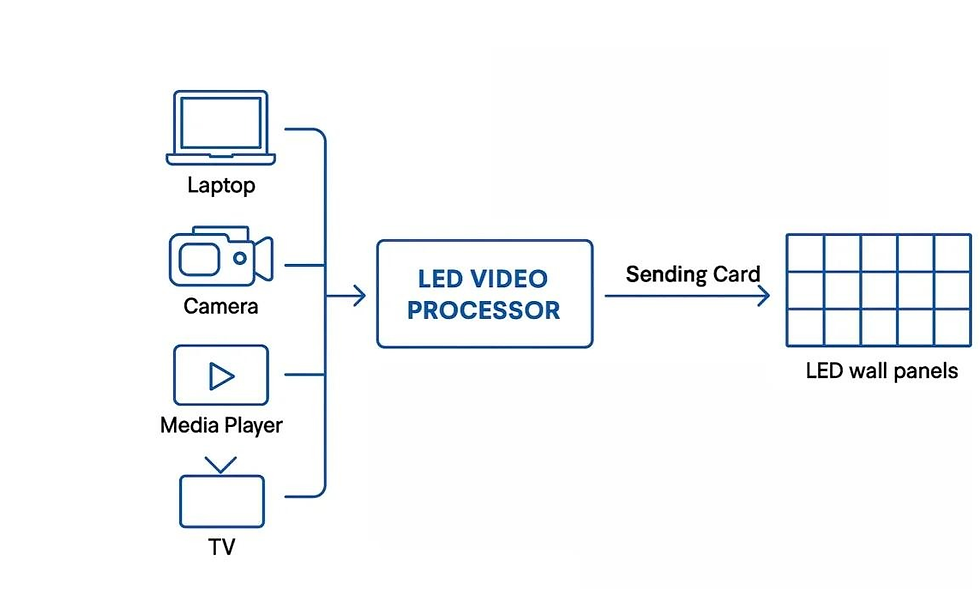
The working principle of a small pixel pitch LED display system can be understood as a complete chain of signal input, processing, transmission, decoding, display output, and status monitoring.
3.1 Signal Input
The system first receives signals from multiple input sources. Depending on the project, these may include HDMI, DP, DVI, VGA, SDI, or network video streams.
In practical installations, it is common to combine several types of content on one screen, such as:
Live surveillance video
Computer desktops
Presentation materials
Data dashboards
Video conferencing images
Media playback content
3.2 Signal Processing
Once the signal is collected, it enters the processing layer. This function is typically handled by a video processor or distributed control host.
The processor can perform tasks such as:
Signal decoding
Resolution conversion
Image scaling
Multi-window display
Overlay and roaming
Cross-screen display
Noise reduction
Color optimization
Frame synchronization
In higher-end projects, processors may support 4K @ 60Hz signal handling for more demanding image requirements.
3.3 Signal Transmission
After signal processing, the data is sent to the LED control system. A common signal path is:
Signal Source → Video Processor → Sending Card → Communication Link → Receiving Card → LED Module
The sending card acts as the bridge between the processor and the display. It converts the image data into a format suitable for LED transmission.
The receiving card, installed inside the cabinet, receives the signal and controls the LED modules accordingly.
3.4 Display Output
The receiving card decodes the incoming data and maps it to the LEDs on the screen. It manages functions such as:
Scanning
Grayscale control
Refresh rate performance
Module mapping
Signal synchronization
Cabinet communication
Because small pixel pitch displays use densely packed LEDs, they are capable of showing more detailed images at close viewing distances than conventional indoor LED displays.
3.5 Calibration and Monitoring
To maintain image consistency, many systems use point-by-point calibration. This technology adjusts the brightness and color of individual pixels to reduce inconsistency across the screen.
At the same time, modern systems often include monitoring functions such as:
Cabinet online status
Temperature monitoring
Power supply status
Fault detection
Receiving card status
Communication alarms
These features are especially important in professional control room and mission-critical environments.
4. Product Classification
Small pixel pitch LED display solutions can be classified in several ways depending on project needs.
4.1 By Pixel Pitch
This is the most common method of classification. Typical products include:
P2.5
P2.0
P1.8
P1.5
P1.2
A smaller pixel pitch generally means higher pixel density and better image detail at shorter viewing distances. However, it also usually means a higher system cost.
4.2 By Application Type
Command center displays
Conference room LED displays
Monitoring room video walls
Exhibition and showroom screens
Auditorium and report hall displays
4.3 By Cabinet Design
Standard die-cast aluminum cabinets
Ultra-thin cabinets
Front-service cabinets
Rear-service cabinets
Custom-shaped cabinets
4.4 By Control Mode
Synchronous display systems
Distributed display systems
Centralized processor-based systems
Multi-source visualization systems
4.5 By Maintenance Access
Front maintenance
Rear maintenance
Front and rear dual maintenance
5. Applications
Small pixel pitch LED displays are widely used in indoor professional environments where image detail, long-term stability, and seamless presentation are important.
5.1 Government, Security, and Emergency Command
These systems are commonly used in:
Police command centers
Emergency response centers
Government monitoring halls
Military coordination rooms
They are suitable for these environments because they support continuous operation, detailed information display, and seamless large-format visualization.
5.2 Transportation and Energy Control Centers
Typical use cases include:
Airport operation centers
Rail transit monitoring centers
Highway command centers
Power dispatch centers
Oil and gas monitoring rooms
These locations require real-time display of monitoring feeds, maps, alarms, and operational dashboards.
5.3 Finance and Telecommunications
Fine pitch LED displays are also used in:
Banking monitoring centers
Financial data halls
Telecom network control centers
Data center operation rooms
These scenarios require the display of charts, real-time metrics, and multiple application windows with good visual clarity.
5.4 Education, Weather, and Environmental Monitoring
Examples include:
Smart campus control centers
Lecture halls
University exhibition areas
Meteorological monitoring centers
Environmental data halls
5.5 Commercial and Corporate Spaces
Common applications include:
Enterprise showrooms
Brand exhibition halls
Conference rooms
Auditoriums
Public information display areas
6. Advantages
Small pixel pitch LED display solutions offer several important advantages in indoor professional applications. As display technology continues to develop, these systems have become a preferred choice for projects that require seamless presentation, clear image detail, and stable long-term operation. Compared with many traditional large-format display options, fine pitch LED systems provide stronger flexibility and better visual integration.
6.1 Seamless Display Surface
One of the biggest advantages of a small pixel pitch LED display is its seamless visual effect. Unlike LCD video walls, which usually have visible bezels between panels, LED cabinets can be assembled into a nearly continuous display surface. This creates a more unified image and greatly improves the viewing experience.
A seamless screen is especially valuable in applications such as command centers, monitoring rooms, and data visualization environments, where the content often includes maps, dashboards, tables, video feeds, and real-time control interfaces. In these cases, visible panel borders can interrupt the image and reduce information readability. A seamless LED display helps present all content more clearly and professionally.
6.2 High Resolution for Close Viewing
Small pixel pitch LED displays are designed for environments where people view the screen from a relatively short distance. Because the LEDs are packed more densely, the display can present finer details, smoother lines, and clearer text than conventional larger-pitch LED screens.
This is particularly important in indoor spaces such as conference rooms, exhibition halls, financial monitoring centers, and operation rooms, where users may need to read charts, spreadsheets, interface windows, or detailed graphics. A smaller pixel pitch improves the ability of the display to show high-resolution content without obvious pixelation, resulting in a more comfortable and accurate viewing experience.

6.3 Better Image Uniformity and Color Consistency
With the support of point-by-point calibration and mature LED control technology, small pixel pitch LED displays can achieve strong uniformity in brightness and color. This helps reduce common display issues such as brightness inconsistency, color deviation, or uneven image areas.
For professional applications, image consistency is extremely important. When a display wall is used for presentations, branding, or operational monitoring, uneven brightness can affect both the visual quality and the professionalism of the project. Fine pitch LED solutions are generally designed to maintain more stable performance across the full screen, which makes them suitable for demanding visual environments.
6.4 Flexible Size and Installation Design
Another important advantage is flexibility. Small pixel pitch LED displays are modular systems, which means they can be configured in different sizes and aspect ratios according to project requirements. This is much more flexible than many fixed-size display solutions.
Whether the project requires a standard conference room screen, a large control room wall, or a custom-sized display for a showroom, LED cabinets can usually be combined to match the space. Some projects may also require curved structures, corner installations, or creative display shapes, and modular LED systems are often better suited for these custom needs.
6.5 Lightweight Cabinet Structure
Many small pixel pitch LED products use die-cast aluminum cabinets or other lightweight structural materials. This brings several practical advantages during transportation, installation, and maintenance.
A lighter cabinet reduces structural pressure on the mounting system and building surface. It can also improve installation efficiency and make cabinet alignment easier in some project conditions. For wall-mounted or large-scale indoor display projects, lightweight design is often a useful engineering benefit.
6.6 Stable Long-Term Operation
Professional small pixel pitch LED display systems are usually designed for long operating hours and continuous use. In applications such as command centers, transportation hubs, energy dispatch centers, and security monitoring rooms, the display often needs to run for extended periods every day. In some cases, it may operate 24/7.
With suitable power supply design, heat management, and control system support, fine pitch LED displays can offer reliable long-term performance. This makes them a strong option for environments where system stability is more important than simple visual presentation alone.
6.7 Maintenance Efficiency
Modern fine pitch LED systems are typically designed with maintenance convenience in mind. Depending on the cabinet structure, the project may support front maintenance, rear maintenance, or both. Key components such as modules, receiving cards, and power supplies can often be replaced individually.
This modular maintenance design helps reduce downtime and improves service efficiency. For customers operating in critical environments, the ability to quickly locate and replace a faulty component can reduce operational risk and maintenance cost over time.
6.8 Stronger Overall Presentation Value
In addition to technical advantages, small pixel pitch LED displays also offer stronger visual impact and presentation value. A seamless, high-resolution LED wall can create a more modern and professional appearance for corporate spaces, exhibition halls, briefing centers, and public information areas.
For many organizations, the display is not only a tool for showing content but also part of the overall image of the space. A well-designed LED display system can improve both practical communication efficiency and the visual quality of the environment.
7. Limitations
Although small pixel pitch LED display solutions offer many benefits, they also come with certain limitations. Understanding these limitations is important for buyers, consultants, and system integrators because it helps ensure the selected solution matches the real needs of the project.
7.1 Higher Initial Investment
One of the most common challenges is the relatively high upfront cost. Compared with standard indoor LED displays or some conventional video wall solutions, small pixel pitch LED systems usually require a larger initial investment.
This is not only because of the LED screen itself, but also because the full project may include video processors, sending cards, receiving cards, mounting structures, control software, power distribution systems, and installation services. As the pixel pitch becomes smaller, manufacturing precision and material requirements also increase, which usually pushes the project cost higher.
7.2 Greater System Complexity
A small pixel pitch LED display is not a simple plug-and-play product. In most professional projects, it functions as part of a larger visualization or control system. This means the success of the project depends on coordination across multiple technical layers.
Signal compatibility, processor selection, control system configuration, cabinet mapping, software commissioning, and network planning all need to be considered. If one part of the system is not properly matched, the final display performance may be affected. This complexity means projects often require experienced technical teams for design, integration, and after-sales support.
7.3 Higher Requirements for Installation Precision
Fine pitch LED displays require more precise installation than many conventional display systems. Cabinet alignment, structural flatness, gap control, and module-level consistency all have a direct impact on the final visual effect.
If the installation is not accurate, the screen may show uneven lines, visual distortion, or poor surface uniformity. In small pixel pitch applications, these issues can be more noticeable because viewers are usually positioned closer to the screen. As a result, installation quality becomes a critical part of overall project quality.
7.4 Power and Thermal Management Requirements
Although modern products continue to improve in efficiency, power distribution and heat management remain important considerations. Large LED screens still consume a meaningful amount of power, especially in projects with long daily operating hours.
In addition, stable internal temperature helps protect the performance and lifespan of LEDs, driver ICs, and power modules. If a project does not include proper ventilation, thermal planning, or electrical design, long-term stability may be affected. This is why engineering design remains essential even for indoor display installations.
7.5 Content and Signal Quality Still Matter
A fine pitch LED display can only perform as well as the system feeding it. If the input signal quality is poor, the processor configuration is weak, or the source content is not suitable for the screen resolution, the final display result may not meet expectations.
For example, low-resolution source material shown on a high-resolution LED wall may still look soft or low quality. Similarly, poor signal routing or weak image processing may reduce the performance benefits of the display hardware. In other words, a premium screen alone cannot guarantee premium visual results.
7.6 Maintenance and Service Planning Are Necessary
Although modular design improves maintenance efficiency, small pixel pitch LED systems still require professional service planning. Spare parts, calibration tools, trained technicians, and maintenance access all need to be considered in advance.
In some projects, especially those with limited rear space or complex wall structures, maintenance conditions may become challenging if not planned properly during the design phase. Long-term support from reliable suppliers or local service partners is therefore an important part of the purchasing decision.
7.7 Total Cost of Ownership May Be Higher
The purchase price is only one part of the total investment. Buyers should also consider long-term costs such as electricity usage, spare parts, software support, calibration needs, maintenance labor, and future upgrades.
In some cases, a system that appears less expensive at the beginning may create higher operational costs later. Because of this, project evaluation should focus not only on initial price but also on lifecycle value and support capability.
7.8 Not Every Project Needs Fine Pitch
Another limitation is that small pixel pitch LED is not always the most cost-effective choice for every indoor application. If the viewing distance is relatively long or the content does not require very high detail, a larger pixel pitch product may provide sufficient performance at a lower cost.
For this reason, buyers should avoid selecting a smaller pitch simply because it seems more advanced. The best solution should be based on actual application needs, viewing distance, operational goals, and budget planning.
8. Selection Guide
When selecting a small pixel pitch LED display solution, buyers should evaluate the full system rather than focusing only on pixel pitch or cabinet appearance.
8.1 Compatibility
Check whether the screen is compatible with:
Video processors
Sending cards
Receiving cards
Control software
Cabinet communication architecture
Third-party systems
Compatibility is one of the most important factors in successful integration.
8.2 Resolution and Pixel Pitch
Choose the pixel pitch according to:
Viewing distance
Content type
Screen size
Installation environment
Budget
A smaller pitch is not always necessary if the viewing distance is long enough.
8.3 Loading Capacity
The control system should support the full screen resolution. Important points include:
Sending card loading capacity
Receiving card loading capacity
Port allocation
Screen resolution planning
Redundancy requirements
8.4 Communication Method
Depending on the project, the system may use:
Standard network communication
Fiber transmission
Distributed IP architecture
Redundant communication links
8.5 Reliability
For critical projects, buyers should consider:
Redundant power supplies
Backup control paths
Industrial-grade components
Real-time fault alarms
Online health monitoring
8.6 Maintenance Method
Maintenance access directly affects service convenience and operating cost. It is important to confirm whether the project requires front maintenance, rear maintenance, or both.
8.7 Control Requirements
Some projects only need basic content display, while others require:
Multi-window management
Preset scene recall
Remote operation
Permission management
Platform integration
Real-time signal switching
8.8 Long-Term Cost
In addition to the purchase price, buyers should also evaluate:
Energy consumption
Spare parts availability
Maintenance frequency
Service support
Upgrade path
9. Brands
The small pixel pitch LED display market includes different types of suppliers.
9.1 LED Display Manufacturers
These companies mainly provide cabinets, modules, and screen hardware, sometimes together with integrated control solutions.
9.2 LED Control System Suppliers
Some vendors specialize in sending cards, receiving cards, controllers, and software platforms. These suppliers are important because display stability depends heavily on control system performance.
9.3 Video Processor and Visualization Solution Providers
In more advanced projects, the processor layer is a key part of the system. These suppliers focus on signal routing, multi-window display, distributed visualization, and system integration.
9.4 System Integrators and Engineering Partners
In real projects, local integrators often play a critical role in system design, installation, debugging, and after-sales service.
When evaluating brands, it is useful to compare:
Product consistency
Control system maturity
Integration capability
Technical support
Spare parts supply
Project experience
Local service ability
10. Conclusion
A small pixel pitch LED display solution is a professional indoor display system built for seamless presentation, high image detail, and stable long-term operation.
Its value does not come only from the pixel pitch itself, but from the complete system behind it, including signal sources, video processors, sending cards, receiving cards, control software, cabinet communication, thermal design, and maintenance strategy.
For engineers, system integrators, procurement teams, and B2B buyers, the best approach is to evaluate the solution from a full-system perspective. Factors such as compatibility, resolution, control architecture, reliability, serviceability, and lifecycle cost are all important.
When properly selected and integrated, small pixel pitch LED display systems can support a wide range of professional applications, including command centers, conference rooms, monitoring halls, exhibition spaces, and corporate visualization projects.
FAQ
What is a small pixel pitch LED display?
A small pixel pitch LED display is an indoor LED screen with a pixel pitch of P2.5 or below, designed for close viewing and high-resolution applications.
What are the common pixel pitch options?
Common pixel pitch options include P2.5, P2.0, P1.8, P1.5, and P1.2.
What is the difference between a small pixel pitch LED display and an LCD video wall?
The main difference is that a small pixel pitch LED display offers a seamless image without visible bezels, while LCD video walls usually have visible panel borders between screens.
Where are small pixel pitch LED displays commonly used?
They are commonly used in command centers, conference rooms, monitoring halls, exhibition spaces, financial data centers, and transportation control rooms.
What should buyers consider before choosing a system?
Key factors include pixel pitch, viewing distance, compatibility, control system design, maintenance access, reliability, and total lifecycle cost.


Comments