
LED Traffic Display Screen: Complete Guide to ITS Traffic LED Systems
- Tse Cherie
- 4 days ago
- 10 min read

An LED traffic display screen is a specialized outdoor display used in Intelligent Transportation Systems to publish real-time traffic information, warnings, route guidance, lane status, and public service messages. Unlike commercial LED screens used for advertising or entertainment, traffic LED displays are engineered for visibility, stability, and long-term operation in harsh outdoor environments.
In a typical LED control system, the traffic display screen functions as the field-level output terminal. It receives instructions from the traffic management platform, processes display commands through the controller architecture, and presents critical information clearly to drivers. Whether the application is a highway variable message sign, an urban guidance board, a radar speed display sign, or a parking guidance screen, the system must support high brightness, reliable communication, environmental protection, and continuous operation.
For engineers, system integrators, procurement teams, and B2B buyers, understanding how an ITS traffic LED system works is essential for project planning and product selection. This guide explains the technology from a practical industry perspective, including its role, working principles, product categories, applications, advantages, limitations, selection criteria, and common brand types.
1. Overview

An LED traffic display screen is an outdoor information display terminal designed specifically for road traffic use. Its primary purpose is to communicate time-sensitive information to drivers in a format that can be recognized quickly and safely. Typical display content includes congestion alerts, accident warnings, lane control instructions, speed reminders, weather notices, route diversion guidance, and parking availability.
These products are widely used in:
Highways and expressways
Urban arterial roads
Toll plazas and ETC lanes
Tunnels and interchanges
Transport hubs
Public and commercial parking facilities
From a system architecture perspective, the screen itself is only one part of the overall solution. A complete traffic LED display system usually includes:
Data acquisition devices
Traffic control or information publishing software
Communication and transmission infrastructure
Display control hardware
Outdoor LED display terminals
Remote monitoring and maintenance tools
This means the real value of an LED traffic display screen lies not only in the display hardware, but also in how well it integrates with the broader ITS environment.
2. Functional Positioning
In the overall LED control system, the LED traffic display screen serves as the visual execution terminal of the transportation information chain.
Its functional role can be understood through three layers:
Upstream: Data and Event Sources
The system receives information from multiple traffic-related sources, such as:
Checkpoint and license plate recognition systems
Radar speed detectors
Traffic flow monitoring sensors
Weather monitoring equipment
Toll collection and ETC systems
Parking management platforms
Manual operator input from a traffic command center
These systems provide the raw data that determines what needs to be shown.
Middle Layer: Intelligent Processing and Control
The traffic platform or control software analyzes incoming data and converts it into display instructions. Depending on the project, this may involve:
Rule-based message triggering
Real-time congestion response
Dynamic route guidance
Lane status management
Manual emergency publishing
Scheduled public information release
This layer determines the content, priority, timing, and destination of each message.
Downstream: Display Output to Road Users
The LED traffic display screen receives the display command and turns it into visual output. At this stage, components such as the controller, sending card, LED receiving card, driver ICs, power supply, communication interfaces, and cabinet structure all affect final performance.
So from a system perspective, the screen is not just a display surface. It is the physical output node where traffic intelligence becomes actionable roadside information.
3. Working Principles
The working principle of an LED traffic display system can be summarized as a closed operational loop: data collection, logic processing, signal transmission, display output, and status feedback.
3.1 Data Collection
The process begins with field data collection. Typical data sources include:
Traffic cameras and violation capture systems
Radar and speed detection units
Vehicle flow sensors
Visibility and weather sensors
Toll station lane management systems
Parking occupancy systems
Manual dispatch terminals
These devices continuously feed status information into the management platform.
3.2 Information Processing
The control platform evaluates incoming data and determines what information should be displayed. For example:
A detected accident may trigger a warning message upstream
Heavy congestion may activate route diversion guidance
Fog detection may trigger low-visibility warnings and speed advisories
A closed toll lane may display a lane closure symbol
Parking availability changes may update remaining space numbers in real time
This processing may be fully automatic, semi-automatic, or manually controlled depending on system complexity.
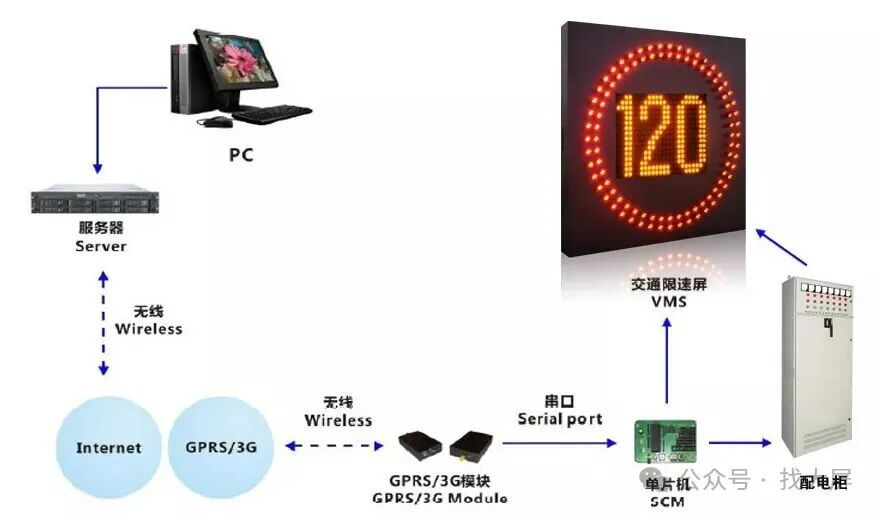
3.3 Signal Transmission
Once content is generated, it must be transmitted reliably to the display terminal. In many projects, the signal chain follows this path:
Traffic platform / control software → controller or sending device → network transmission → receiving card → LED modules
In large or distributed deployments, communication often relies on:
Fiber optic transmission
Ethernet
Industrial serial communication
Wireless backup networks
Dual-link redundancy
For long-distance roadside deployment, fiber is commonly preferred because it supports stable, low-latency transmission and better resistance to interference.
3.4 Display Rendering
At the cabinet level, the LED receiving card decodes the incoming data and maps it to the LED modules. It controls scanning, grayscale, refresh, and module communication, ensuring that characters, arrows, lane indicators, symbols, and numeric values are displayed accurately.
3.5 Status Monitoring and Feedback
In professional traffic projects, the display system also supports operational feedback, such as:
Communication status
Power condition
Brightness sensor response
Temperature alarms
Cabinet faults
Controller online status
This allows centralized monitoring and remote maintenance, which is especially important for distributed roadside infrastructure.
4. Product Classification
LED traffic display products can be classified in several practical ways.
4.1 By Functional Application
Variable Message Signs (VMS)
These are large traffic information displays used on highways and major roads. They typically show road conditions, construction notices, accident warnings, weather alerts, and route guidance.
Lane Control Signs
These displays are installed above traffic lanes, toll booths, or tunnel approaches. They show lane open or closed status, arrows, crosses, speed limits, and ETC or manual lane indicators.
Radar Speed Display Signs
These systems combine speed detection with LED display output. They are commonly installed on urban roads, school zones, ramps, and controlled corridors to show vehicle speed and alert drivers when limits are exceeded.
Urban Traffic Guidance Screens
Used in city traffic networks, these screens provide congestion alerts, district guidance, turn suggestions, and diversion information based on current traffic conditions.
Parking Guidance Displays
These screens display total spaces, available spaces, zone-based parking information, and directional guidance within parking environments.
4.2 By Installation Form
Gantry-mounted displays
Cantilever-mounted displays
F-type roadside structures
Pole-mounted signs
Wall-mounted screens
Over-lane indicators
Installation form usually depends on road width, visibility requirements, structural conditions, and jurisdictional standards.
4.3 By Display Format
Text-only displays
Text and symbol displays
Numeric traffic information displays
Matrix-based message displays
Multi-zone traffic guidance displays
Traffic applications generally prioritize clarity and recognition speed over rich visual effects.
4.4 By Control Method
Local standalone control
Centralized network control
Distributed remote control
Dual-controller redundant control
The control method should match the communication environment and operational importance of the site.
5. Applications
LED traffic display screens are used in a wide range of transportation scenarios because they can deliver clear, real-time information under outdoor operating conditions.
5.1 Highways and Expressways
This is one of the most common application areas. Highway variable message signs are used to display:
Accident warnings
Construction notices
Weather alerts
Temporary speed control
Lane restrictions
Route diversion guidance
These environments require long viewing distance, high brightness, strong structural stability, and dependable communication.
5.2 Urban Traffic Management
In urban road networks, LED traffic displays are used at major intersections, arterial roads, and congestion-prone corridors. They help cities publish:
Congestion guidance
Route recommendations
Safety reminders
Violation-related notices
Event or emergency traffic instructions
Urban projects benefit from fast information updates and close integration with centralized traffic control software.
5.3 Toll Plazas and ETC Lanes
At toll stations, LED lane indicators guide vehicles efficiently into open lanes and distinguish between ETC and manual channels. This improves throughput and reduces confusion in high-density traffic environments.

5.4 Tunnels, Bridges, and Interchanges
These locations often involve higher operational risk and more complex vehicle movements. LED displays are used to provide:
Entry warnings
Speed reminders
Lane usage information
Emergency evacuation instructions
Hazard alerts
5.5 Parking Guidance Systems
Parking LED screens are commonly installed in shopping centers, residential complexes, office parks, airports, hospitals, and transport hubs. They reduce unnecessary internal circulation by guiding drivers directly to available spaces or zones.
5.6 Industrial Parks and Logistics Sites
In logistics parks and large campuses, LED displays can be used for truck routing, gate assignment, parking management, safety reminders, and internal traffic coordination.
6. Advantages
LED traffic display systems offer several practical benefits in transportation infrastructure projects.
6.1 High Visibility in Outdoor Environments
These displays are designed for bright sunlight, rain, fog, and changing ambient conditions. Automatic brightness adjustment improves readability while reducing glare at night.
6.2 Real-Time Information Publishing
Dynamic message updates allow road authorities and operators to respond quickly to accidents, congestion, roadwork, and changing weather conditions.
6.3 Strong Integration Capability
Traffic LED screens can work with ITS platforms, speed radar, parking systems, weather stations, traffic sensing devices, and centralized control software.
6.4 Reliable Continuous Operation
Compared with general-purpose display products, traffic-grade systems are usually designed for 24/7 operation, industrial communication, and higher environmental tolerance.
6.5 Improved Traffic Guidance Efficiency
By translating real-time traffic conditions into visible route guidance and warnings, these displays can support smoother traffic distribution and faster driver decision-making.
6.6 Energy Management Potential
With intelligent brightness control and optimized power design, many systems can reduce unnecessary energy consumption during long-term operation.
7. Limitations
A realistic evaluation should also consider the limitations of LED traffic display systems.
7.1 Higher Initial Investment
Compared with static signs or simple information boards, LED traffic displays usually require more spending on hardware, structures, communication, and system integration.
7.2 Greater System Complexity
These are not standalone consumer displays. Deployment often involves traffic platform integration, field power design, communications engineering, and sometimes civil installation work.
7.3 Maintenance Can Be Challenging
Many installations are on gantries, roadside poles, or high-risk traffic zones. This can increase maintenance difficulty, response time, and service cost.
7.4 Content Design Is Purpose-Limited
Traffic screens are built for quick recognition and operational clarity. They are not suitable for media-heavy visual presentation or complex user interaction.
7.5 Performance Depends on Upstream Systems
Even a high-quality display terminal cannot perform well if sensor inputs, control logic, or software integration are weak.
8. Selection Guide
When selecting an LED traffic display screen, buyers should evaluate the entire system rather than focusing only on display appearance or brightness. The following criteria are especially important.
8.1 Compatibility
Confirm compatibility with the broader LED control system, including:
Sending card and receiving card architecture
Control software
Communication protocol
Third-party ITS platform integration
Cabinet communication requirements
Compatibility problems are a common source of project delays and maintenance issues.
8.2 Resolution and Pixel Pitch
Pixel pitch should match the actual reading distance, installation height, road speed, and content type. A smaller pitch does not automatically mean better performance in outdoor traffic applications.
8.3 Loading Capacity
The controller and receiving card configuration must support the required pixel load, cabinet count, and message format. This is especially important for large VMS boards and multi-zone displays.
8.4 Communication Method
Choose the appropriate transmission method based on project distance, interference environment, and reliability requirements. Common options include:
Fiber optic transmission
Ethernet
Serial communication
Wireless backup
8.5 Reliability and Redundancy
For critical road infrastructure, consider:
Dual-computer hot backup
Dual-network redundancy
Surge and lightning protection
Fault alarm mechanisms
Remote health monitoring
Stable industrial power design
8.6 Environmental Protection
Outdoor traffic displays should be assessed for:
IP protection level
Water and dust resistance
Temperature tolerance
Anti-corrosion treatment
Structural wind resistance
Thermal management design
8.7 Maintenance Convenience
Check whether the system supports easy module replacement, controller access, power supply servicing, and remote diagnostics. Maintenance design directly affects lifecycle cost.
8.8 Control Requirements
Some projects require only simple scheduled messages, while others need dynamic route logic, lane-level control, speed-linked alerts, or parking data integration. Choose the platform and controller architecture accordingly.
8.9 Long-Term Operating Cost
Energy use, spare parts availability, maintenance frequency, and service accessibility should all be considered in addition to upfront cost.
9. Brands
The traffic LED display market includes several types of suppliers, and the right choice often depends on project scale, integration depth, and service expectations.
9.1 LED Display Manufacturers
These suppliers mainly provide the physical display hardware, such as cabinets, LED modules, structural integration, and sometimes controller bundling.
9.2 LED Control System Providers
Some companies are better known for their sending card, LED receiving card, controller solutions, and software ecosystem. These suppliers are important when compatibility and control stability are a priority.
9.3 ITS Solution Providers
These companies focus on broader transportation applications, combining software platforms, traffic logic, communication systems, and field devices into a unified solution.
9.4 Regional Integrators and OEM Suppliers
Local integrators and OEM manufacturers are often important in projects that require customization, local certification, or fast service response.
When evaluating brands, it is useful to compare them across the following dimensions:
Product reliability
Control system maturity
Integration capability
Spare parts support
Local service availability
Experience in traffic or industrial outdoor projects
Software usability
Maintenance ecosystem
A practical purchasing strategy is to evaluate the display hardware, control platform, and implementation partner as one combined solution.
10. Conclusion
An LED traffic display screen is a critical visual terminal in modern transportation infrastructure. It converts traffic data, control logic, and operational instructions into clear roadside information that drivers can understand immediately.
Its value is not limited to the display panel itself. A well-designed ITS LED traffic display system depends on coordinated performance across sensing devices, control software, communication networks, sending and receiving card architecture, and outdoor hardware reliability. That is why engineers, integrators, and buyers should assess the system as a complete operational chain rather than as a standalone screen product.
For highways, urban roads, toll plazas, tunnels, parking facilities, and logistics environments, LED traffic display systems can support safer traffic management, better information delivery, and more efficient vehicle guidance. The key to successful selection lies in matching the product to actual application needs, control requirements, environmental conditions, and long-term maintenance strategy.
FAQ Section for Wix
What is an LED traffic display screen?
An LED traffic display screen is an outdoor LED information display used in transportation systems to show traffic warnings, route guidance, lane status, speed information, and public notices.
How is an LED traffic display different from a commercial LED screen?
A traffic LED display is designed for outdoor readability, 24/7 operation, environmental protection, and integration with traffic control systems, while commercial LED screens are usually focused on media presentation and advertising.
Where are LED traffic display screens commonly used?
They are commonly used on highways, urban roads, toll plazas, tunnels, interchanges, parking facilities, logistics parks, and transport hubs.
What components are included in an LED traffic display system?
A complete system may include traffic data sources, control software, communication infrastructure, sending devices, receiving cards, LED cabinets, power supplies, and remote monitoring tools.
What should buyers consider when selecting a traffic LED display?
Key factors include compatibility, pixel pitch, controller loading capacity, communication method, environmental protection, redundancy, maintenance convenience, and integration with upstream traffic systems.
Suggested CTA for the End of the Wix Post
If you are planning a highway, urban traffic, tunnel, toll, or parking guidance project, it is worth evaluating the LED traffic display system from both the hardware and system integration perspective. A well-matched architecture can improve long-term reliability, simplify maintenance, and support more effective traffic information delivery.


Comments