
Complete Guide to Asynchronous LED Display Network Setup and Configuration
- Tse Cherie
- May 5
- 4 min read

As digital signage continues evolving toward cloud-based management and distributed large-scale deployments, asynchronous LED display systems have become the preferred solution for stable, independent, and remotely controlled operation.
This technical guide provides a structured overview of:
· System architecture
· Working principles
· Network configuration methods
· Product classification
· Deployment strategies
The document follows professional LED technical documentation standards to ensure clarity, engineering accuracy, and SEO optimization.
1. System Overview
An asynchronous LED display system is a digital signage solution that stores media content locally within the LED controller and plays it according to preset schedules, without requiring a continuous real-time HDMI or video source.
Unlike synchronous LED systems that rely on external video input signals, asynchronous systems operate independently. Once content is uploaded and scheduled, playback continues automatically—even if the network connection is temporarily interrupted.
This independent architecture makes asynchronous LED controllers particularly suitable for:
· Outdoor LED billboards
· Roadside traffic LED displays
· Mobile LED advertising trucks
· Urban digital signage networks
· Campus-wide information boards
· Retail and chain-store advertising screens
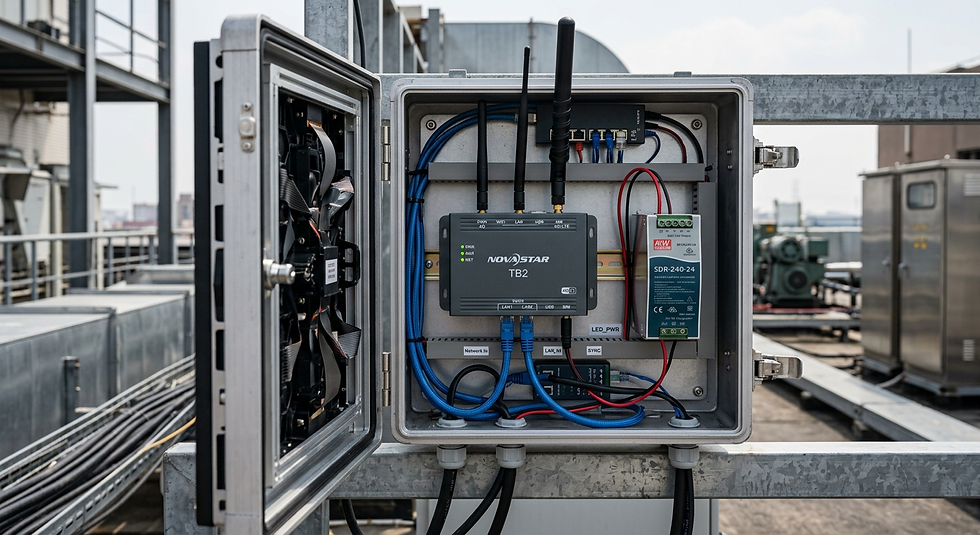
By integrating Ethernet, Wi-Fi, or 4G/5G communication modules, asynchronous LED display controllers support remote content publishing, system diagnostics, and centralized multi-screen management through platforms such as NovaStar VNNOX cloud.

2. System Role & Functional Positioning
2.1 Functional Positioning
Asynchronous LED controllers function as:
· Content storage terminals
· Media playback engines
· Scheduling processors
· Remote communication nodes
· Cloud-managed display endpoints
They are specifically designed for projects where:
· Real-time video input is not required
· Long-term unattended operation is critical
· Remote content updates are necessary
· Multi-location LED screen management is required
· Operational and maintenance cost reduction is a priority
This positioning makes asynchronous systems highly efficient for advertising networks and infrastructure displays.
2.2 Position in LED System Architecture
In a standard LED display structure:
· Receiving Card → Responsible for signal decoding and LED module control
· Sending Card (Synchronous) → Handles real-time signal transmission
· Asynchronous Controller → Integrates storage, playback, scheduling, and network communication
In non-live scenarios, the asynchronous controller replaces traditional sending systems, simplifying overall hardware structure and reducing system complexity.
3. Working Principles
3.1 Content Workflow
1. Media content is uploaded via ViPlex Express or VNNOX Cloud Platform.
2. The controller stores media in internal flash memory.
3. Playback schedules are configured (daily, weekly, timed events, or recurring tasks).
4. The controller outputs data signals to LED receiving cards.
5. The LED display executes content automatically according to preset timing.
6. Playback logs and device status can be remotely monitored for verification and diagnostics.
This autonomous architecture ensures continuous display operation without dependency on external computers or video sources.
3.2 Network Communication Modes
Asynchronous LED controllers support triple-mode connectivity:
· Wired Ethernet
· Wi-Fi (STA Mode)
· 4G/5G Cellular Network
Network priority is typically configured as:
1. Wired connection
2. Wi-Fi
3. Cellular backup
If the primary network fails, the controller can automatically switch to an available backup network to maintain cloud connectivity and remote management capability.
3.3 Cloud Communication Requirements
To ensure stable VNNOX cloud access and secure LED controller communication:
· Open ports: 80, 443, 8800
· Whitelist domain: *.novastar.tech
· Allow outbound firewall access
· Ensure proper DNS resolution
· Confirm APN configuration for cellular modules
All communication data is encrypted using secure protocols to prevent unauthorized access and ensure data integrity.

4. Product Classification
Asynchronous LED controllers can be categorized by networking method, deployment scale, and application environment.
4.1 Classification by Network Method
(1) Wired Ethernet Controllers
· DHCP enabled by default
· Supports static IP configuration
· Compatible with enterprise VLAN networks
· Provides highest stability and lowest latency
· Suitable for 24/7 permanent installations
Typical applications include shopping malls, transportation hubs, municipal advertising systems, and industrial parks.
(2) Wi-Fi Controllers (STA Mode)
· Connect via router SSID and password
· Supports WPA/WPA2 encryption
· Suitable for wall-mounted retail displays
· Enables fast installation without structured cabling
· Requires stable and tested signal coverage
Signal strength testing is recommended before final installation to prevent packet loss and network instability.
(3) 4G/5G Cellular Controllers
· Uses industrial-grade IoT SIM cards
· Supports automatic network reconnection
· Suitable for mobile and remote deployments
· Enables cross-region remote LED screen management
· Ideal for vehicle-mounted LED displays
For optimal stability, external antennas are recommended in weak-signal environments.
4.2 Classification by Deployment Scale
Deployment Scale | Typical Scenario | Recommended Controller |
Single Screen | Retail signage | TB1 / TB3 |
Medium Network | Shopping mall cluster | TB3 / TB6 |
Large Urban Deployment | City billboard network | TB8 |
Large-scale deployments benefit from cloud grouping, centralized scheduling, and batch firmware management capabilities.
6. Advantages
6.2 Remote Cloud CMS Integration
Through the VNNOX platform, users can:
· Upload and publish media remotely
· Monitor device temperature, voltage, and storage status
· Check network signal strength
· Schedule brightness and power timing
· Group-control multiple displays
· Perform remote firmware upgrades
· Access playback proof and reporting logs
This centralized cloud-based LED management system significantly reduces on-site maintenance frequency and improves operational efficiency.
7. Limitations
Despite their flexibility and scalability, asynchronous LED controllers have certain technical constraints:
1. Do not support real-time HDMI or live broadcast input
2. Not suitable for stage events or live sports streaming
3. Cellular backup activates only if wired/Wi-Fi is unavailable
4. Industrial SIM cards may require port and domain authorization
5. Cellular modules must match regional frequency bands
6. Limited internal storage compared to dedicated media servers
7. Dependent on stable power supply for scheduling accuracy
For real-time broadcasting applications, synchronous LED systems remain the recommended solution.
10. Conclusion
Asynchronous LED display systems provide a stable, scalable, and cost-efficient solution for modern digital signage and cloud-managed LED networks.
Their ability to operate independently while maintaining secure remote connectivity makes them ideal for:
· Urban billboard networks
· Mobile LED advertising vehicles
· Campus and hospital signage systems
· Regional multi-store advertising deployments
· Remote infrastructure communication boards
By implementing proper network configuration using ViPlex Express and enabling secure VNNOX cloud access, users achieve:
· Centralized control
· Reliable offline playback
· Scalable device management
· Reduced operational costs
For projects requiring unattended, remotely managed, and cloud-connected LED displays, asynchronous controllers offer an optimal balance between flexibility, system stability, and long-term efficiency.


Comments